Booster Box or Singles: 7 Honest Rules for Smart Buying
Booster box or singles is the question every collector faces sooner or later. You want cards from a set. You can buy a sealed booster box and open it, with all the excitement and uncertainty that involves, or you can buy the exact cards you want, one at a time, and know precisely what you are getting. Both are good ways to collect. They suit different goals, and choosing the wrong one for your goal is the most common way collectors overspend.
This guide gives you seven honest rules for deciding between a booster box and single cards. It explains what a booster box actually contains, how the cost of chasing a particular card adds up, when sealed product is the better choice, and how to buy well whichever way you go. The rules apply to Pokémon, One Piece, Magic: The Gathering, Lorcana, sports cards and any other game sold in packs.
There is no universally right answer. There is a right answer for what you want, and the rules below will help you find it.
In this guide
What a booster box actually is
A booster box is the sealed display carton that a shop would open to sell individual packs. It holds a fixed number of booster packs from a single set, and it is wrapped at the factory. The pack count depends on the game: a standard English Pokémon main-set booster box holds 36 packs, an English One Piece booster box holds 24, and sports card hobby boxes vary widely from product to product.
What a booster box does not contain is a guarantee of any particular card. Every pack is random within the rules of that set. Over a whole box you can expect a reasonable spread of the set’s commons and uncommons, a number of rare cards, and a handful of the scarcer “hit” cards. Which hits, and how many, varies from box to box. Two boxes from the same case can produce very different results.
That randomness is the whole point of a booster box, and also the whole risk.
Rule 1: If you want one specific card, buy the single
This is the most important rule, and the one most often ignored. If there is a particular card you want, buying that card directly is almost always cheaper than opening packs until you find it.
The arithmetic is simple. The most desirable cards in a modern set are deliberately scarce. Any one specific top-rarity card may appear only once in several booster boxes, and for the very rarest, once in several cases. If a card turns up on average once in every ten boxes, then on average you would need to open ten boxes to find it, and you could easily open twenty and still not have it.
Compare that with the price of the single. Even an expensive card usually costs far less than the number of boxes you would have to open to pull it. The price of a single card is, in effect, the market’s calculation of exactly this trade-off, made by thousands of people who have already opened the boxes.
So when the goal is a card, buy the card. You can browse Pokémon single cards and graded cards in our shop.
Rule 2: Buy a booster box for the experience, not the profit
People sometimes buy a booster box expecting the cards inside to be worth more than the box cost. On average they are not. If opening a booster box reliably returned more than its price, everyone would do it, sealed boxes would sell out instantly, and prices would adjust until the advantage disappeared. In practice, the average value of the contents of a box is usually below what the box sells for, sometimes well below.
Some boxes do beat the odds, and those are the ones people post about. For every one of them there are many ordinary boxes that nobody mentions. Deciding on the basis of the lucky ones is how budgets get broken.
What a booster box really offers is an experience: the anticipation, the surprise, the pleasure of seeing a whole set unfold pack by pack, often with other people. That is worth paying for. Treat the price of the box as the cost of an enjoyable activity, and treat anything valuable you pull as a bonus.
Rule 3: A booster box is the cheapest way to open packs
If you have decided you want to open packs, a booster box is nearly always the most economical way to do it. Divide the price of the box by the number of packs, and the cost per pack is usually lower than buying the same packs individually or in smaller products.
Other sealed products charge for extras. An Elite Trainer Box includes sleeves, dice and a storage box. A collection box includes promo cards and sometimes a figure or pin. Those extras have value if you want them, and they are a good reason to choose those products. But if your aim is simply the most packs for your money, the booster box wins. Our guide to booster boxes compared with Elite Trainer Boxes and bundles sets out the differences.
One caveat applies to Pokémon. Certain special sets are not sold as English booster boxes at all, only in Elite Trainer Boxes, bundles and collections. For those sets the comparison is between those products, and the price per pack still tells you which is the better buy.
Rule 4: Open a booster box to start a set, then finish with singles
For set collectors, the two approaches work best together. A booster box gives you most of the commons and uncommons of a set in one go, along with a share of the rares and a few hits. That is an efficient start, because buying hundreds of low-value cards one by one is tedious and the postage adds up.
After one box, though, the returns fall quickly. A second booster box gives you mostly duplicates, with a few new cards among them. A third gives you even fewer. The remaining gaps in your set are, increasingly, exactly the scarce cards that are unlikely to appear.
The efficient pattern is one booster box, or two for a large set, followed by singles for everything still missing. Collectors who keep opening boxes to finish a set end up with a mountain of duplicate bulk and the same few holes.
Rule 5: If you keep a booster box sealed, treat it as a long-term hold
Some collectors buy a booster box with no intention of opening it. Sealed product from sets that go out of print can rise in value over the years, because the supply of unopened boxes only ever shrinks while new collectors keep arriving.
This can work, but be realistic about it. Not every set appreciates. Sets that were printed in very large quantities, or that are reprinted later, can stay flat for a long time. A sealed booster box ties up money and space, and it earns nothing while it sits. Prices can fall as well as rise, and there is no guarantee at all.
If you do hold sealed product, condition is everything. The value of a sealed booster box depends on intact factory shrink wrap and undamaged corners. Store boxes flat or upright, never under heavy stacks, away from heat and sunlight, ideally in fitted acrylic cases. Our trading card storage guide covers sealed product as well as cards.
Rule 6: Know what you are buying before you pay
Whichever route you choose, a few checks prevent the most expensive mistakes.
For a booster box:
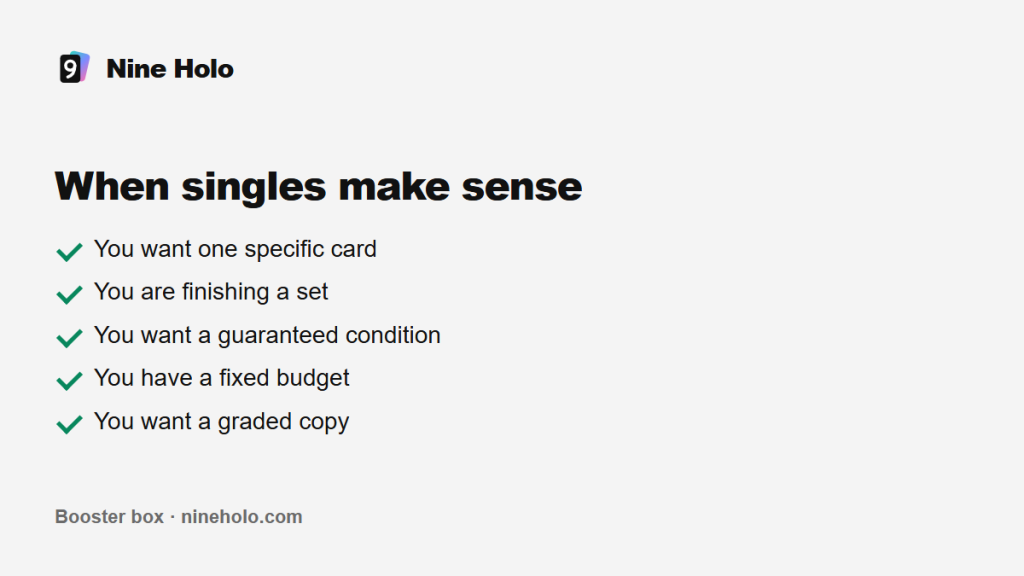
- Confirm the exact product. Check the set name, the language and the pack count. Japanese boxes are often smaller than English ones and are priced differently.
- Look at the wrap. Genuine sealed boxes have tight, clean factory wrap, often printed with a logo pattern. Loose, cloudy or badly seamed wrap can mean a box has been opened and re-wrapped.
- Work out the price per pack and compare it with other sellers.
- Buy from a seller you can reach, who shows the actual item and has a clear returns process.
For singles:
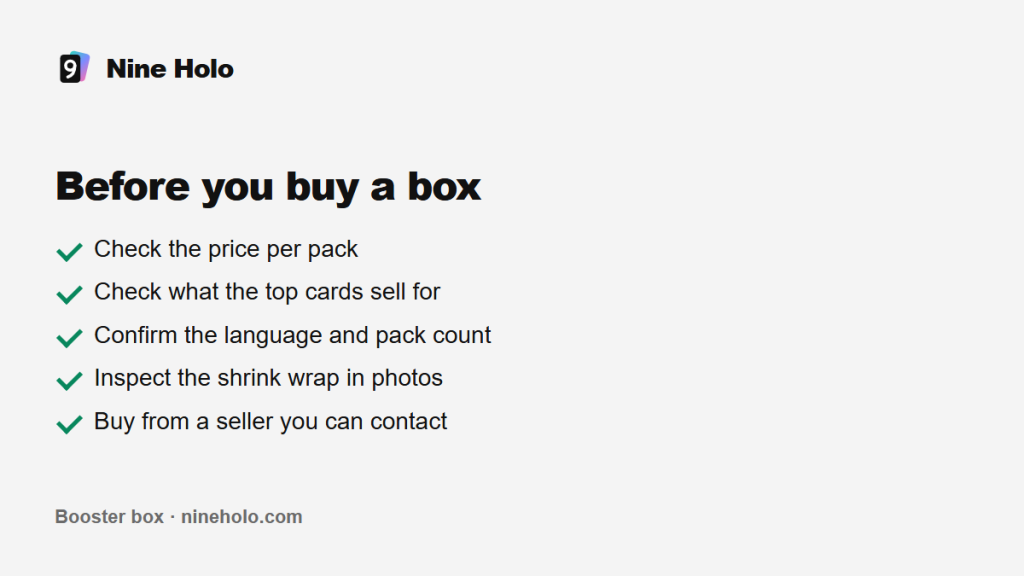
- Check the exact version. The same card can exist in several versions with different values.
- Check the condition stated and the photographs. Our card condition guide explains the terms.
- Check authenticity. For Pokémon, our guide to fake Pokémon cards lists the signs. For expensive cards, consider a graded copy.
- Check sold prices, not asking prices, to see what the card really goes for.
Rule 7: Set the budget first, then choose
The last rule ties the others together. Decide how much you want to spend before you decide what to buy. A fixed amount makes the choice clear.
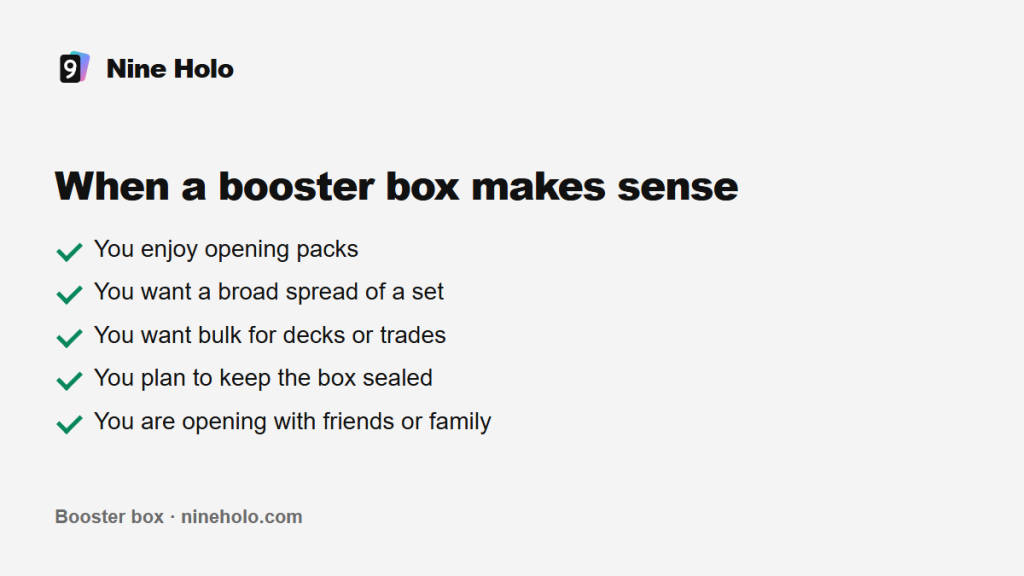
If the budget is small and there is a card you love, buy that card and enjoy owning it. If the budget covers one booster box and what you want is an evening of opening packs, buy the box and enjoy every pack. If the budget is larger and you want a complete set, split it: a booster box to begin, and the rest kept back for singles.
What rarely works is starting with one plan and switching halfway. Buying a booster box, missing the card you wanted, and then buying another box and another is how collectors spend several times the price of the single and still end up buying the single.
How the choice differs by game
The rules above hold everywhere, but the details vary a little.
- Pokémon. A main-set booster box has 36 packs. Special sets come only in boxes and collections. The top cards are special illustration rares, which are scarce enough that singles are nearly always the cheaper route to a specific one. See Pokémon booster boxes.
- One Piece. A booster box has 24 packs. The alternate art and manga rare cards are extremely scarce, so chasing them through boxes is especially costly. See One Piece booster boxes and our introduction to the One Piece Card Game.
- Sports cards. The equivalent decision is between a hobby box and singles. Hobby boxes often promise a number of autographs or memorabilia cards, but not of any particular player. If you collect one player, buy that player’s cards. See sports card hobby boxes and our guide to hobby boxes compared with retail boxes.
- Magic: The Gathering and Lorcana. Boxes come in several types aimed at players or collectors. Read what each type contains, because the mix of cards differs.
What about the cards you do not want?
A booster box leaves you with a lot of cards you did not particularly want: duplicates, commons and uncommons known as bulk. It is worth having a plan for them.
- Trade them. Other collectors need the cards you have twice.
- Build decks. Bulk is the raw material for playing the game.
- Give them away. Bulk makes a welcome gift for a child starting out.
- Sell the better ones. Duplicate rares and hits can be sold individually to fund the singles you still need.
- Store the rest properly. Rows in a card storage box take little space.
Singles avoid this entirely, which is one of their quiet advantages. Every card you buy is one you chose.
Where graded cards fit in
There is a third option for the cards that matter most: buying them already graded. A graded card has been authenticated and scored for condition by a company such as PSA, Beckett or CGC, and sealed in a protective case.
This removes two uncertainties at once. You know the card is genuine, and you know its condition before you pay. A card pulled from a booster box is not automatically in top condition, since factory flaws are common, so the graded copy can be the surer route to a high-grade example. Our explanation of the PSA grading scale shows what each number means.
A worked example
Numbers make the choice clearer. Imagine a set where sealed product costs 150 for a display of 36 packs, and the card you want most sells for 80 as a single. Suppose that card appears, on average, once in every eight displays.
To pull it yourself you would expect to open eight displays, at a cost of 1,200, and there is a real chance you would still not have it. Along the way you would collect a large pile of other cards, some of them valuable, and you could sell those to recover part of the money. But selling takes time, involves fees and postage, and rarely brings back anything close to what was spent. Buying the single costs 80 and takes one order.
Now change the goal. Suppose you do not care about any one card. You want to spend an evening opening packs with your family, and you want a good start on the set. One display at 150 gives you 36 packs, most of the commons and uncommons, and a handful of better cards. Buying the same spread of cards one at a time would be slow and would miss the point entirely.
The figures here are invented to show the reasoning, and real prices and pull rates vary from set to set. The method does not change: estimate how many displays it would take to find the card, multiply by the price, and compare the result with the single.
How prices move after release
Timing affects both sides of the decision. When a set is new, single cards are usually at their most expensive, because few copies have been opened and everyone wants them at once. Over the following weeks, as more product is opened, most singles fall in price. Only the most sought-after cards tend to hold or rise.
Sealed product behaves differently. While a set is in print and easy to find, prices stay close to the normal retail level. Once printing stops and shops sell through their stock, sealed prices can begin to climb. That is why older sets often cost far more to open than new ones.
The practical conclusion is patience. If you want singles from a new set, waiting a few weeks often saves money. If you want to open a set, it is usually cheapest while it is still current. And if a set has been out of print for years, singles are nearly always the economical way to collect it.
Frequently asked questions
Is it cheaper to buy a booster box or singles?
For specific cards, singles are almost always cheaper. For a broad spread of a set, or simply the most packs for your money, a booster box is the better buy.
Can you make money opening a booster box?
Occasionally, but not reliably. On average the cards in a box are worth less than the box. Open boxes because you enjoy it.
How many packs are in a booster box?
It depends on the game and the language. Standard English Pokémon main sets have 36, and English One Piece sets have 24. Always check the product description.
Is a booster box guaranteed to contain a top-rarity card?
No. A booster box contains a typical number of hits for that set, but no specific card is guaranteed, and the number varies from box to box.
Should I keep a booster box sealed?
Only if you are happy to hold it for years with no guarantee of a gain, and you can store it safely. If you would rather enjoy it now, open it.
The short version
Buy singles when you want specific cards, a known condition or a fixed cost. Buy a booster box when you want the experience of opening packs, a wide spread of a set, or sealed product to keep. For a complete set, start with one booster box and finish with singles. Set the budget first, check exactly what you are buying, and do not chase a single card through box after box.
Ready to choose? Browse sealed booster boxes across every game, or go straight to every listing in our shop.