PSA Grading Scale: 10 Grades Every Smart Collector Should Know
The PSA grading scale is the most widely used language for describing the condition of a trading card. When a listing says “PSA 9” or “PSA 10”, it is using the PSA grading scale to tell you, in a single number, how close that card is to perfect. The number matters a great deal, because on a sought-after card the gap between one grade and the next can be a large multiple of the price.
This guide explains the PSA grading scale in plain language. It covers what each of the ten grades means, how half grades and qualifiers work, what the graders actually look at, how to read the label on a slab, and what to check before you buy a graded card. It applies to Pokémon, sports cards, One Piece and every other kind of trading card that PSA grades.
PSA stands for Professional Sports Authenticator. It is one of several companies that authenticate cards, assess their condition and seal them in a tamper-evident plastic case called a slab. You can find the company’s own published standards on the PSA website.
In this guide
What the PSA grading scale is
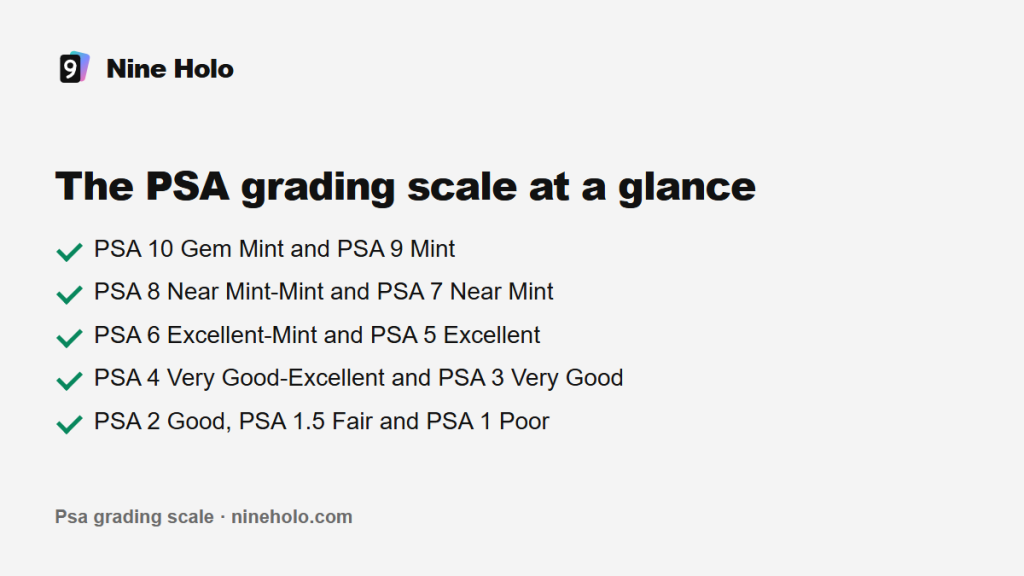
The PSA grading scale runs from 1 to 10. A 10 is the highest grade and a 1 is the lowest that still receives a number. Each number has a name, such as Gem Mint or Near Mint, and each describes a level of wear that the card is allowed to show.
Two things happen when a card is graded. First, the card is authenticated: the grader confirms that it is genuine and has not been altered, for example by trimming an edge or recolouring a worn area. Second, the card’s condition is assessed against the PSA grading scale and a grade is assigned. The card is then sealed in a slab with a label showing what it is, the grade, and a unique certificate number.
The grade describes condition only. It says nothing about how rare or desirable the card is. A common card in PSA 10 can be worth very little, and a famous card in PSA 3 can be worth a great deal.
The four things graders look at
Every grade on the PSA grading scale is decided by the same four attributes. Understanding them is the key to understanding why a card received the grade it did.
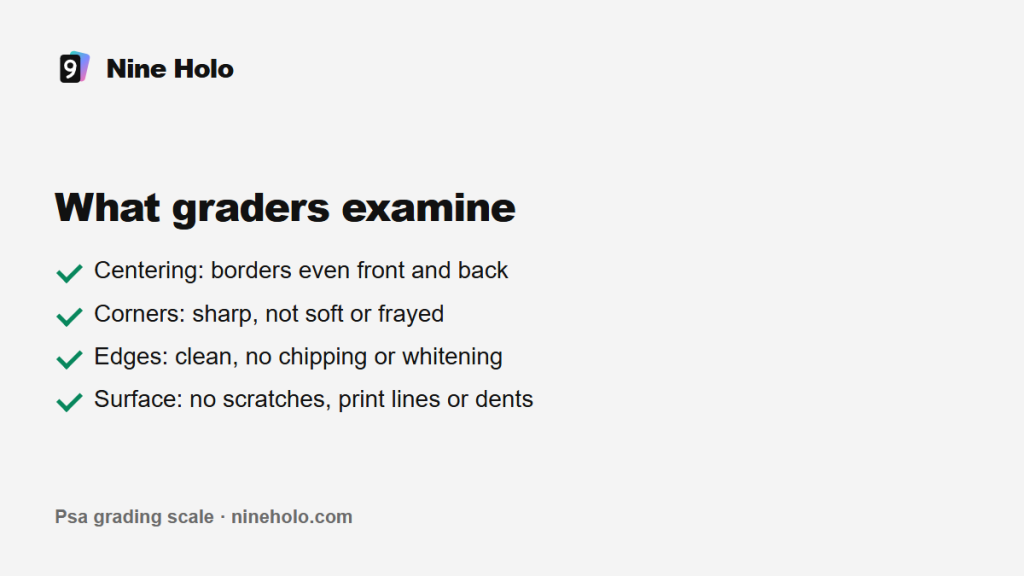
- Centering. How evenly the image sits within the borders, measured left to right and top to bottom, on both the front and the back. Centering is decided when the card is cut at the factory and cannot be improved afterwards.
- Corners. Sharp, square corners score highest. Rounding, fraying, soft tips and layers starting to separate all lower the grade.
- Edges. Graders look for chipping, roughness and the white flecks that appear where the coloured surface has worn away, often called whitening.
- Surface. Scratches, print lines, dents, stains, wax marks, loss of gloss and fading all count against the card. Holographic surfaces show scratches particularly easily.
On the PSA grading scale, a card’s grade is generally held back by its weakest attribute. A card with perfect corners, edges and surface can still fall short of the top of the PSA grading scale because it is noticeably off-centre.
PSA 10: Gem Mint
PSA 10 is the top of the PSA grading scale. A Gem Mint card is, for practical purposes, perfect: four sharp corners, clean edges, full original gloss and no staining of any kind. Centering must be very close to even, with a little more tolerance on the back than on the front. PSA allows a very minor printing imperfection as long as it does not affect the overall look of the card.
Cards straight from a pack do not automatically reach the top of the PSA grading scale. Factory flaws such as slight off-centre cuts, print lines and tiny edge nicks are common, which is why PSA 10 copies are scarcer than people expect and why they carry the highest prices.
PSA 9: Mint
A PSA 9 is a superb card with one small flaw. That might be a very slight wax stain on the back, a minor printing imperfection, or centering that is a little outside the standard for a 10. To the naked eye, most Mint cards look perfect, and many collectors cannot tell a 9 from a 10 without magnification.
Because the visual difference is so small and the price difference is often large, PSA 9 is where many collectors find the best value on the PSA grading scale.
PSA 8: Near Mint-Mint
A PSA 8 looks like a Mint card at first glance and reveals small flaws on closer inspection. Typical examples are the slightest fraying at one or two corners, a minor printing imperfection, or centering that is somewhat off. The surface still has its gloss and the card presents very well.
For vintage cards, which have had decades to pick up wear, an 8 on the PSA grading scale is a high grade and often an expensive one.
PSA 7: Near Mint
At PSA 7 the wear becomes visible without searching for it, although it is still light. You may see slight surface wear, minor fraying on some corners, a little loss of original gloss, or a printing blemish. Centering can be further off than in the higher grades. The card is still attractive and clearly well looked after.
PSA 6: Excellent-Mint
A PSA 6 shows visible surface wear or a printing defect that does not detract badly from the card’s appeal. Corners may show light fraying, and there may be a very light scratch that is only visible on close inspection. Some of the original gloss may be gone, and the picture focus may be slightly off.
PSA 5: Excellent
The middle of the PSA grading scale. A PSA 5 has corners that are starting to round, more visible surface wear, and some loss of gloss. There may be minor chipping on the edges and several light scratches. The card is clearly used but remains whole, clean and presentable.
PSA 4: Very Good-Excellent
At PSA 4 the corners are slightly rounded and surface wear is noticeable, with light scuffing or scratches. A light crease may be visible. Much of the original gloss may have gone, and the borders can be somewhat off-white on older cards.
PSA 3: Very Good
A PSA 3 shows rounding at the corners that is not extreme, obvious surface wear and possibly light scuffing or scratches. A crease may be visible. The image may be slightly out of focus and the edges show wear. The card still holds together as a displayable example.
PSA 2: Good
A PSA 2 has accelerated rounding at the corners and obvious surface wear, which can include scratching, scuffing, light staining or chipping of the enamel on the front. There may be several creases. Original gloss may be completely absent. For very old and very scarce cards, a PSA 2 is still a meaningful and collectable grade.
PSA 1.5 and PSA 1: Fair and Poor
The bottom of the PSA grading scale. A PSA 1.5, called Fair, shows extreme wear at the corners and heavy surface wear, but the card remains fully intact. A PSA 1, called Poor, has defects so advanced that the eye appeal has nearly vanished: heavy creasing, major staining, possibly a small piece missing. These grades mainly matter for cards that are so rare that any genuine example is wanted.
Half grades on the PSA grading scale
PSA also uses half-point grades between the whole numbers, such as 8.5 or 6.5. A half grade is given when a card clearly exceeds the standard for its whole-number grade and has especially strong qualities, most often centering, without reaching the next number up.
The top of the scale is the exception. There is no PSA 9.5: a card is either a 9 or a 10. This is one of the main differences between the PSA grading scale and the scale used by Beckett, where 9.5 is a regular and important grade. Our guide to how PSA and BGS grading compare covers that in more detail.
Qualifiers: the letters after the number
Sometimes a card meets the standard for a grade in every way except one significant flaw. Rather than drop the card several grades, PSA can assign the higher grade with a qualifier, a two-letter code printed after the number. A card labelled “PSA 9 (OC)” meets the Mint standard apart from being off-centre.
- OC: off-centre, beyond the tolerance for that grade.
- ST: staining.
- PD: a print defect.
- OF: out of focus.
- MK: marks, such as writing or ink on the card.
- MC: miscut, where part of another card is visible or part of this one is missing.
On the PSA grading scale, a qualified grade is not equal to the same number without a qualifier. Buyers usually value a qualified card about two grades lower, so a PSA 9 (OC) tends to sell closer to a PSA 7. Always read the whole label, not only the number.
Authentic and other label designations
Not every card in a PSA slab has a number from the PSA grading scale. A label that reads “Authentic” means PSA has confirmed the card is genuine but has not assigned a numerical grade. That can happen because the owner asked for authentication only, or because the card has an issue, such as evidence of alteration, that prevents a numerical grade.
Autographed cards may carry two grades, one for the card and one for the signature. Read both. A beautiful signature on a worn card and a worn signature on a beautiful card are very different items.
How to read a PSA label
The label at the top of the slab holds everything you need. It shows the year and the set, the card number and the name of the player or character, any variety such as a holographic or first-edition version, the grade as a number and in words, and the certificate number, which also appears as a barcode or QR code on newer labels.
The certificate number is the most useful part. PSA runs a public lookup on its website: enter the number and you will see the card and grade that PSA recorded, and for many recent submissions a photograph of the actual slab. If the details do not match the slab in your hand, do not buy it.
How the grade affects price
Price rises as you move up the PSA grading scale, and it rises fastest at the top. For modern cards in particular, the step from 9 to 10 is often the largest in the whole scale, because collectors who want the best copy compete for a limited number of Gem Mint examples.
Grading companies publish population reports that show how many copies of a card have received each grade. A card with thousands of PSA 10s behaves very differently in the market from one with a handful. Before paying a premium for a high grade, look at how many others exist and what the grade below sells for. Often the grade one step down gives you nearly the same card for much less.
PSA compared with other grading companies
PSA is not the only company whose slabs you will see. Beckett Grading Services, known as BGS, uses half points throughout its scale and can show four subgrades on the label, one for each attribute. CGC is another established name, especially for Pokémon and other trading card games.
The numbers on the PSA grading scale and on other companies’ scales are not interchangeable. A 9 from one company is not automatically equal to a 9 from another, and the market prices each company’s grades separately. When you compare prices, compare like with like: the same card, the same company and the same grade.
How the PSA grading scale treats vintage and modern cards
The PSA grading scale is the same for a card printed last year and a card printed fifty years ago. What changes is how hard each grade is to reach. Modern cards are printed and cut with far better quality control, and most collectors sleeve them within seconds of opening the pack. As a result, high grades are common for modern cards, and anything below a 9 can be difficult to sell at a premium.
Vintage cards are a different story. They were printed on rougher stock, cut less precisely, and often handled by children, carried in pockets and held together with rubber bands. For these cards the middle of the PSA grading scale is respectable, and a 7 or an 8 can be an exceptional copy. This is why two cards with the same number can sit at very different points in their own markets.
The practical lesson is to judge a grade against the card, not in isolation. Before you decide whether a number is good, find out how many copies exist at that grade and above. The PSA grading scale tells you the condition; the population tells you how unusual that condition is.
What to check before buying a graded card
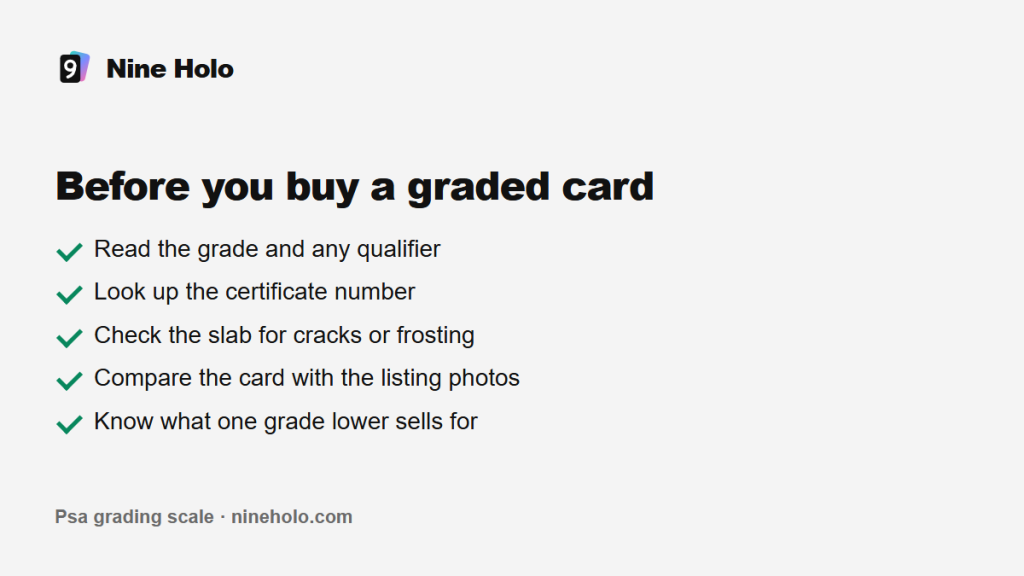
- The exact grade on the PSA grading scale. Two slabs of the same card are different products if the numbers differ. Confirm the grade, and any qualifier, before you pay.
- The certificate number. Look it up on the grading company’s site and make sure it matches.
- The slab. Cracks, frosting along the seam or a loose label can indicate tampering.
- The card inside. Even within one grade, some cards look better than others. Check centering and eye appeal in the photographs.
- The seller. Buy from sellers who show the actual slab and answer questions clearly.
You can browse authenticated cards in our graded cards section, including Pokémon and sports graded singles.
Should you grade your own cards?
Grading costs money and takes time, so it only makes sense when the result is likely to be worth more than the fee, or when you want a favourite card protected and authenticated for its own sake. Be honest about condition before you send anything. Examine the card under a bright light with magnification, check the centering, and compare it with the descriptions on the PSA grading scale above.
Cards most likely to benefit are valuable cards in excellent condition, where a high grade adds a clear premium, and cards where authenticity matters to a future buyer. Low-value cards rarely repay the cost. Whatever you decide, handle and store candidates carefully in the meantime: our trading card storage guide explains how.
Frequently asked questions
Is PSA 10 a perfect card?
Very nearly. The PSA grading scale allows a PSA 10 a very minor printing imperfection and a small tolerance in centering, so it describes a virtually perfect card rather than a flawless one.
Is a PSA 9 worth buying?
Often, yes. A PSA 9 looks almost identical to a 10 and usually costs much less, which makes it a sensible choice if you want a high-quality copy without paying the top premium.
What does a qualifier do to the value?
It lowers it. A qualified grade is typically valued around two grades below the same number without a qualifier.
Can a graded card be regraded?
Yes. Cards can be resubmitted for review or cracked out of the slab and submitted again, but the grade can go down as well as up, and removing a card from a slab risks damaging it.
Does the PSA grading scale apply to sealed packs?
PSA also grades unopened packs, using a similar 1 to 10 approach that reflects the condition of the wrapper. The standards differ from those for single cards.
The short version
The PSA grading scale turns card condition into a number from 1 to 10, based on centering, corners, edges and surface. Ten is Gem Mint and virtually perfect, nine is Mint with one tiny flaw, and each step down allows a little more wear. Half grades reward strong examples, qualifiers flag a single significant fault, and the certificate number lets you confirm that a slab is what it claims to be. Read the whole label, look the number up, and compare prices for the same card, company and grade.