
Fake Pokémon Cards: 11 Easy Ways to Spot a Counterfeit
Fake Pokémon cards are more common than most new collectors expect, and they turn up everywhere: online marketplaces, flea markets, gift shops and even in lots bought from other collectors who did not know what they had. The good news is that fake Pokémon cards are usually easy to identify once you know what to look for, and most checks take less than a minute with nothing more than a genuine card to compare against.
This guide gives you eleven practical checks, from the quick glance to the closer inspection, followed by advice on sealed product, the red flags to watch for in a listing, and what to do if a fake has already reached you. No single test is perfect on its own. Counterfeiters improve, and real cards vary a little between print runs, so the reliable approach is to use several checks together.
One note before starting. Everything here is about telling real from fake so that you can buy with confidence. If you are ever unsure about an expensive card, the safest route is a copy that has already been authenticated by a grading company.
In this guide
Why fake Pokémon cards are everywhere
Pokémon is one of the most collected card games in the world, and popular cards sell for serious money. Wherever a small piece of printed card is worth a lot, counterfeits follow. Fake Pokémon cards range from crude copies sold in bulk as toys to careful imitations of specific valuable cards aimed at collectors.
The crude kind of fake Pokémon cards is by far the most common. These are the shiny gold or rainbow cards sold in boxes of fifty or a hundred for a few dollars, and the booster packs found in discount shops that cost a fraction of the normal price. They are not intended to fool an experienced collector, but they regularly fool parents, gift buyers and children.
The careful kind is rarer and more dangerous, because it targets cards that are worth faking well. With those, the checks below matter most, and comparing against a known genuine copy becomes essential.
1. Compare the back of the card
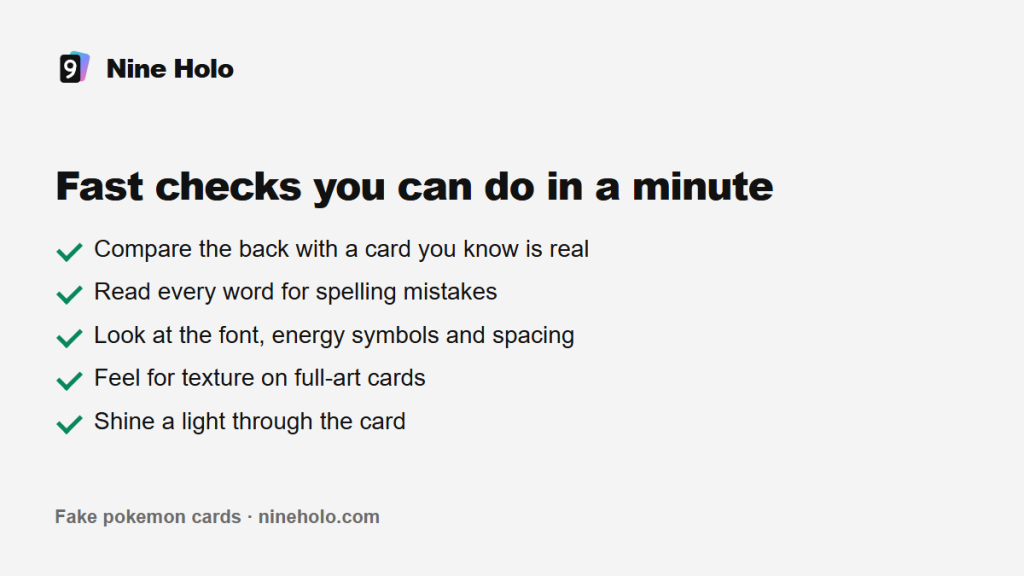
The back is the best place to start, because every English Pokémon card shares the same design and counterfeiters rarely get it exactly right. Put the suspect card next to one you know is real, under good light.
Look at the blue. On genuine cards the back has a rich blue with a mottled, cloud-like pattern of lighter and darker areas. Fake Pokémon cards often show a blue that is too pale, too purple or too flat, with the swirling pattern blurred or missing. Look at the Poké Ball and the border as well. Edges should be crisp, and the border should be an even width.
With fake Pokémon cards, differences in the back are the single quickest giveaway, which is why sellers of fakes often photograph only the front.
2. Read every word on the card
Spelling mistakes and odd grammar remain one of the easiest ways to catch fake Pokémon cards. Read the name, the attack names, the attack text and the small print at the bottom. Genuine cards are carefully proofread. A misspelled Pokémon name, a missing accent on the word Pokémon, a strange capital letter or a sentence that does not quite make sense all point the same way.
Check the numbers as well, because fake Pokémon cards often get them wrong. Hit points and attack damage on real cards follow the game’s rules, so a basic Pokémon with thousands of hit points, or an attack that does an absurd amount of damage, is a fake. So is a card that mixes up elements that never appear together, such as the wrong energy type for that Pokémon.
3. Look closely at the font and symbols
Pokémon cards use specific typefaces, and they are consistent within an era. On fake Pokémon cards the font is frequently a little too thin, too bold or too widely spaced, and the difference is obvious once a real card is beside it. Pay attention to the HP number, the attack costs and the text in the bottom corners.
Energy symbols are another weak point. On real cards they are sharp, correctly sized and neatly centred in their circles. On counterfeits they are often blurry, slightly too large, off-centre or printed in the wrong shade. The set symbol, the card number and the rarity mark in the bottom corner should also be clean and correctly placed.
4. Check the colours and print quality
Genuine cards are printed to a high standard, with sharp lines, smooth colour and fine detail in the artwork. Many fake Pokémon cards look washed out, or the opposite: over-saturated and too dark. Fine lines in the artwork may be fuzzy, and small text can look as though it was scanned and reprinted, which is usually what happened.
A magnifying glass or the zoom on a phone camera helps here, since fake Pokémon cards rarely survive a close look. Real cards are printed in a fine, regular pattern of tiny dots, and solid black text is printed crisply on top. Counterfeits often show a coarser dot pattern, and the black text may be made up of coloured dots rather than solid ink.
5. Feel the card
Handle enough real cards and your fingers learn what they should feel like. Genuine cards have a particular stiffness and a smooth, lightly coated finish. Fake Pokémon cards are often thinner and floppier, or they feel waxy, glossy or plasticky, more like a playing card or a photograph.
Give the card a very gentle flex between your fingers. A real card resists and springs back. Many fakes bend too easily and feel limp. Do this carefully, and never on a card that might be valuable, because bending damages genuine cards too.
6. Look for texture on full-art and special cards
Modern full-art, illustration rare and other high-rarity cards have a fine texture that you can both see and feel: tiny ridges that follow the artwork and catch the light like a fingerprint. This texture is expensive to reproduce, and it is one of the most reliable tests for modern cards.
Fake Pokémon cards that imitate these cards are very often completely smooth and simply glossy. Tilt the card under a lamp. If a card that should be textured shows a flat, mirror-like shine with no ridges, treat it as a fake. Be aware that not every card is supposed to be textured, so check what a genuine copy of that exact card looks like before you judge.
7. Study the holographic pattern
Each kind of holographic card has its own foil pattern, and the pattern on a real card moves in a particular way as the card is tilted. Counterfeits tend to use one generic effect for everything: a flat rainbow sheen that covers the whole card, including parts that should not shine at all, or vertical bars of colour that run straight down the card.
To separate real foil from fake Pokémon cards, compare with photographs or, better, a genuine copy. On a real holographic card the shine is usually limited to specific areas, such as the artwork box or the card’s border, and the effect has depth. A card that is shiny everywhere, with the same oily rainbow on the text box and the borders, is one of the most common forms of fake Pokémon cards.
8. Do the light test
Genuine Pokémon cards are made of layers of card stock with a dark layer in the middle, which blocks most light. Hold the card in front of a bright torch or a phone light in a dim room. A real card lets very little light through and looks mostly opaque.
Many fake Pokémon cards are printed on ordinary single-layer stock, and the light shines straight through them, sometimes clearly enough to see the design on the other side. Test a card you know is real first, so that you have a reference for how much glow is normal. This test is quick and does no harm to the card, which makes it one of the most useful.
You may see advice online to tear a card to look for the dark layer inside. Do not do this to any card you care about. It destroys the card, and the tests above tell you what you need to know.
9. Check the size, cut and edges
Real cards are cut to a consistent size with evenly rounded corners. Stack the suspect card with a few genuine ones and look at the edges of the stack. A card that is slightly taller, shorter, wider or narrower stands out immediately. Fake Pokémon cards often have corners that are rounded too sharply or too gently, and edges that feel rough or look fuzzy.
Look at the edge of the card side-on as well, a spot where fake Pokémon cards are easy to catch. On genuine cards you can often make out the layered construction, with a thin darker line in the middle. Counterfeits printed on single-layer stock show a plain, uniform edge.
10. Weigh up the borders and centering
Poor centering does not make a card fake. Genuine cards are miscut all the time, and off-centre real cards are common. What matters is the border itself. On counterfeits the yellow or silver border is often the wrong shade, too thick or too thin all the way round, or printed with a slightly different texture from the rest of the card.
Check the back border in particular against a real card. If both the colour and the width are different, the centering is not the issue.
11. Ask whether the card exists at all
Some fake Pokémon cards are not copies of anything. They are invented: gold metal-effect versions of popular Pokémon, cards with made-up names and attacks, or real artwork paired with the wrong set symbol and number. A quick search for the card name and number will show whether a genuine version exists and what it looks like.
The official Pokémon Trading Card Game site has a card database covering English releases. If the card in your hand does not match the genuine one in name, number, set symbol and artwork, you have your answer.
How to spot fake Pokémon booster packs and boxes
Sealed product is counterfeited too, and the same care applies. Fake Pokémon cards are frequently sold inside fake packs, so learning the signs protects you twice.
- Price. Sealed product sold far below what every reputable shop charges is the first warning.
- Printing on the pack. Look for blurry logos, wrong colours, spelling mistakes and missing legal text.
- The crimp. Genuine packs have clean, even, machine-made seals at the top and bottom. Fakes are often sealed unevenly or look as though they were glued.
- The feel. Counterfeit packs are often made from thinner, shinier foil and may hold the wrong number of cards.
- Box shrink wrap. Genuine sealed boxes are wrapped tightly and neatly. Loose, cloudy or badly seamed wrap suggests a box has been re-wrapped. Many modern Pokémon boxes use wrap printed with a Poké Ball pattern, so check what the genuine wrap looks like for that product.
Resealed product is a related problem: genuine packaging that has been opened, emptied of the valuable cards and closed again. Buy sealed product only from sellers you have reason to trust. You can see what properly sealed product looks like in our Pokémon booster boxes and Elite Trainer Boxes sections, and our guide to booster boxes compared with Elite Trainer Boxes explains what each should contain.
Red flags when buying online
Most fake Pokémon cards are bought online, where you cannot handle the card before paying. That makes the listing itself your first line of defence.
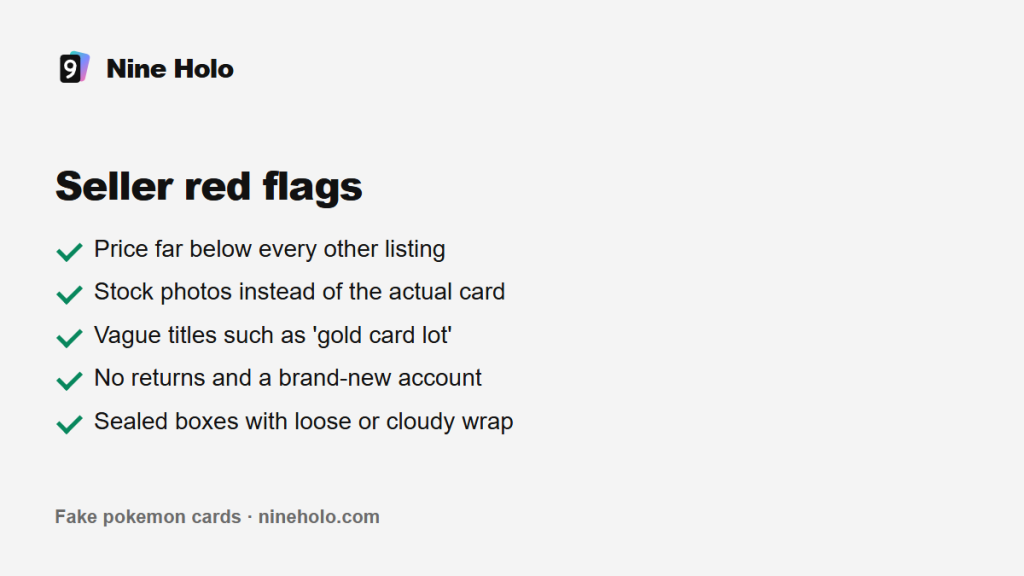
- The price is far lower than every other copy of the same card.
- The photos are stock images, or show only the front.
- The title is vague: “rare gold cards”, “100 card lot guaranteed ultra rares”.
- The seller has a new account, little feedback, or feedback only for unrelated cheap items.
- The seller refuses to send more photos, or will not show the back.
- Returns are not accepted and the description says “sold as is” or “proxy” in small print.
Ask for clear photographs of the actual card, front and back, out of the sleeve if possible and under good light. An honest seller will usually provide them without fuss. If something feels wrong, walk away. There is always another copy.
Where fake Pokémon cards are most often sold
Knowing where fake Pokémon cards circulate helps you decide how careful to be. The risk is not the same everywhere.
- Bulk lots and “mystery” bundles. Boxes that promise large numbers of rare cards for a low price are the most common home of fake Pokémon cards. Genuine rare cards are not sold by weight.
- Discount shops, market stalls and tourist shops. Packs sold far below the usual price, in packaging that looks slightly wrong, are a frequent source.
- Large online marketplaces. Most listings are genuine, but anyone can open an account, so the checks in this guide apply to every purchase.
- Second-hand collections. Collections built by children often contain a few fakes mixed in with real cards, through no fault of the seller.
Specialist card shops and established sellers are much safer, because their business depends on repeat customers and they inspect what they buy. Even so, it is worth running the quick checks on anything expensive. Checking takes a minute, and it builds the habit that protects you when you do meet fake Pokémon cards.
Are graded cards safe from fakes?
Grading companies authenticate a card before they grade it, which is the main reason collectors pay extra for graded copies of valuable cards. A card in a genuine slab from a recognised company such as PSA, Beckett or CGC has been examined by people who see fake Pokémon cards every day.
The slab itself can be counterfeited, though, so there is one more check to make. Every slab carries a certificate number, and each company offers a lookup on its website. Enter the number and confirm that the card, the grade and, where shown, the photographs match the item in front of you. Inspect the case for signs that it has been opened and re-sealed, such as frosting or cracks along the edges.
Our guide to how PSA and BGS grading works explains the labels and the grades, and you can browse authenticated cards in our Pokémon graded singles section.
What to do if you bought fake Pokémon cards
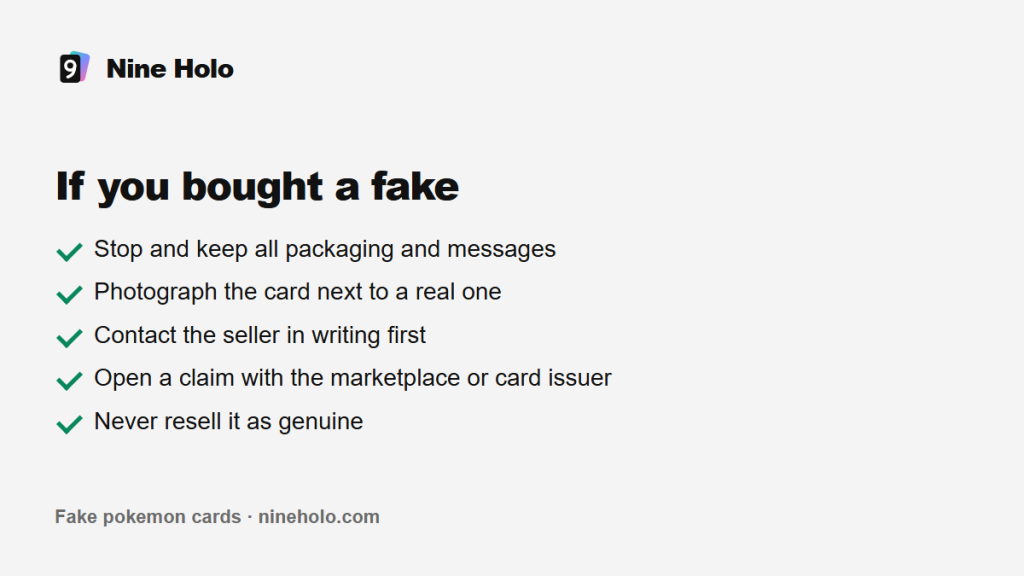
First, do not panic and do not throw anything away. Keep the card, the packaging and every message with the seller. Take clear photographs of the card beside a genuine one, showing the differences you found.
Contact the seller in writing and explain the problem calmly. Some sellers genuinely do not know what they sold and will refund you. If the seller refuses or does not answer, open a claim through the marketplace’s buyer protection, or with your card issuer if you paid by card. Counterfeit goods are covered by most buyer protection schemes, and the photographs you took will support the claim.
Do not resell the cards as genuine, and do not pass them on without saying what they are. Fake Pokémon cards also cannot be used in official tournaments. If you keep them, mark them clearly so they never get mixed back into your collection or anyone else’s.
Frequently asked questions
Are fake Pokémon cards worth anything?
No. They have no collector value, they cannot be graded, and selling them as real is fraud. At best they are toys.
Are all gold Pokémon cards fake?
No, but most of the cheap ones are. Genuine gold-coloured cards exist in several sets, and there have been official metal promotional cards. The gold cards sold in bulk boxes for a few dollars are not genuine.
Can a card be real if it fails one test?
Yes. Print runs vary, and a single difference is not proof. That is why you should combine several checks. A card that fails three or four of them is almost certainly fake.
Does off-centre printing mean a card is fake?
No. Genuine cards are often off-centre. Centering affects the grade, not the authenticity.
What is the single best test for fake Pokémon cards?
Comparing the card side by side with a genuine one from the same era. The back, the font and the feel will usually settle it in seconds, and the light test confirms it.
The short version
Fake Pokémon cards give themselves away through the details. Compare the back with a real card, read the text, look at the font and symbols, feel the card, check for texture and the right holographic pattern, and shine a light through it. Buy from sellers who show the actual card and accept returns, and for expensive cards choose an authenticated, graded copy whose certificate number you have checked yourself.
Once you have genuine cards, keep them that way: our guide to trading card storage covers sleeves, holders and the conditions cards need. You can also browse all Pokémon cards in our shop.