Pokémon Card Rarity: 12 Symbols Every Smart Collector Should Know
Pokémon card rarity is printed on every card, and learning to read it is one of the first skills a collector needs. That small symbol in the bottom corner tells you how hard the card was to pull from a pack, and it is the quickest way to sort a pile of cards into the ones that are probably bulk and the ones that deserve a closer look.
This guide explains Pokémon card rarity from the beginning. It covers the three classic symbols, the newer marks introduced with the Scarlet & Violet series, the names collectors use for special cards, where promos fit in, and why rarity and value are not the same thing. It focuses on English-language cards, with a short section on how Japanese cards differ.
You do not need to memorise everything. Once you know where to look and what the main symbols mean, the rest follows naturally as you handle more cards.
In this guide
Where to find the Pokémon card rarity symbol
On modern cards, the Pokémon card rarity symbol sits in the bottom corner of the card, beside the collector number and the set code. On older cards it is in the bottom right corner; on Scarlet & Violet era cards it moved to the bottom left along with the rest of the set information. It is small, so tilt the card towards the light if you have trouble seeing it.
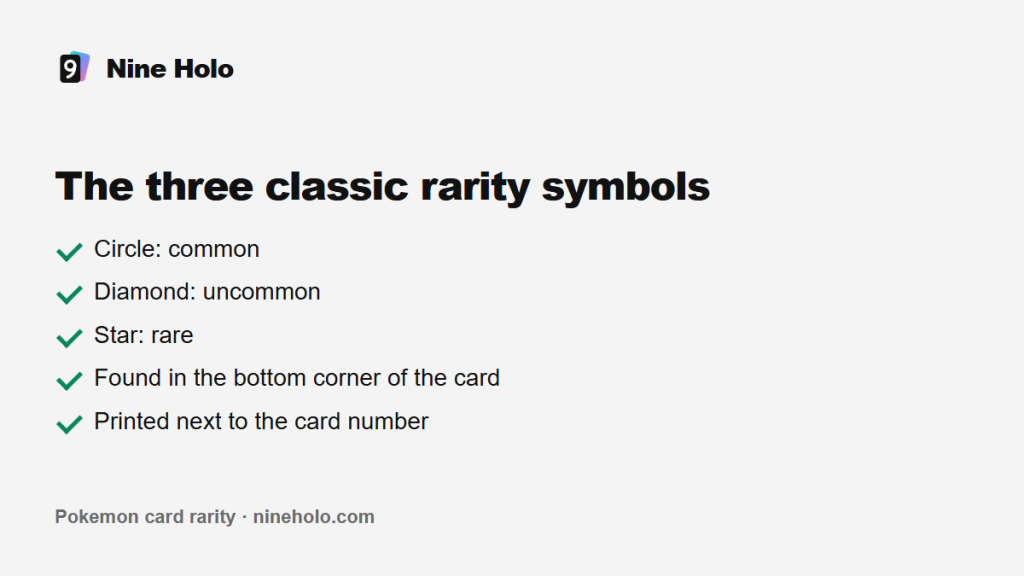
The collector number next to it is written as two numbers separated by a slash, such as 045/198. The first is the card’s number and the second is the size of the main set. That pair of numbers turns out to be important for spotting the rarest cards, as you will see below.
1. Circle: common
A small black circle is the lowest level of Pokémon card rarity. Commons make up most of every booster pack. They are usually basic Pokémon and the first stages of evolution lines, and they are printed in very large numbers. Individually they are worth little, though players need them and complete-set collectors need every one.
2. Diamond: uncommon
A black diamond marks an uncommon card, the second step of Pokémon card rarity. Each pack contains several. Uncommons are often evolved Pokémon and Trainer cards, and some Trainer cards that are heavily played in the game can be worth more than their rarity suggests.
3. Star: rare
A black star marks a rare card, the third classic level of Pokémon card rarity. For most of the game’s history, each booster pack guaranteed at least one card with a star. Rares may be non-holographic or holographic, where the artwork box has a foil finish. A holographic rare is often called a holo rare, and in older sets the holo rares are the cards most collectors remember.
These three symbols, the circle, the diamond and the star, are the foundation of Pokémon card rarity. Everything else is built on top of them.
4. Reverse holo: a finish, not a rarity
A reverse holographic card has foil on everything except the artwork box, the reverse of a normal holo. Almost any common, uncommon or rare in a set can appear as a reverse holo, and most packs include at least one. The rarity symbol on a reverse holo is the same as on the regular version of that card, so it is better thought of as a parallel finish than as its own level of Pokémon card rarity. Reverse holos are usually worth a little more than the plain version.
5. Double rare: two black stars
The Scarlet & Violet series, which began in 2023, redesigned the symbols so that the higher rarities are easier to tell apart. The first of the new marks is two black stars, for a double rare. These are the standard versions of the powerful Pokémon ex cards. They are shiny, they are useful in the game, and they are the most common of the “hit” cards in a modern pack.
6. Ultra rare: two silver stars
Two silver stars mark an ultra rare, the next step up in Pokémon card rarity. These are full-art cards, where the artwork covers the whole face of the card, including full-art Pokémon ex and full-art Supporter cards showing a Trainer character. They have the fine textured surface that modern collectors look for, and they are noticeably harder to pull than double rares.
7. Illustration rare: one gold star
A single gold star marks an illustration rare, a newer level of Pokémon card rarity. These cards show a Pokémon in a full-card illustration, often in a scene that tells a small story, drawn by a wide range of artists. Illustration rares have become some of the most popular cards in modern sets, because the art is the attraction rather than the card’s strength in the game.
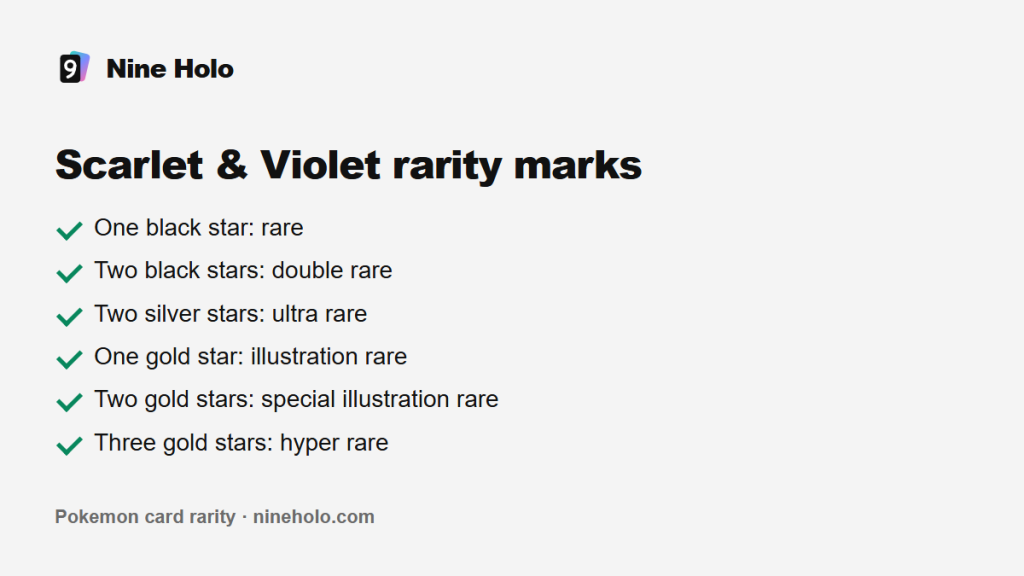
8. Special illustration rare: two gold stars
Two gold stars mark a special illustration rare. These are the premium art cards of a set: full-card illustrations of Pokémon ex and of Supporter characters, with texture and elaborate artwork. In most modern sets the single most valuable card is a special illustration rare. This is the level of Pokémon card rarity that drives a lot of the excitement around opening packs.
9. Hyper rare: three gold stars
Three gold stars mark a hyper rare, the top of the regular Pokémon card rarity scale. In the Scarlet & Violet series these are the gold cards, with a gold border and a textured gold finish, and they include Pokémon ex, Trainer cards and Energy cards. They are among the hardest cards to pull, although collector demand for them is often lower than for the best special illustration rares.
10. ACE SPEC and other special marks
Some cards carry their own symbol rather than a number of stars. ACE SPEC cards, which returned to the game during the Scarlet & Violet series, are powerful Trainer and Energy cards with a distinctive pink design and their own rarity mark. Players may include only one ACE SPEC card in a deck, which is part of what makes them interesting.
Shiny Pokémon, which show a Pokémon in its alternate colours, have appeared with their own shiny rare marks in certain special sets. These vary from set to set, so if you meet a symbol you do not recognise, look up that set’s rarity guide.
11. Secret rare: a number higher than the set size
A secret rare is any card whose collector number is higher than the set size printed after the slash. If a set is listed as having 198 cards and your card is numbered 230/198, it is a secret rare. The name comes from the fact that these cards sit outside the official count.
In modern sets, illustration rares, special illustration rares and hyper rares are all numbered beyond the set size, so they are all secret rares in this sense. Checking the number is therefore a fast and reliable test of Pokémon card rarity: if the first number is bigger than the second, you are holding one of the harder cards to pull.
12. Promo: the black star with the word PROMO
Promotional cards are not pulled from ordinary booster packs. They come in Elite Trainer Boxes, collection boxes, tins, at events, with products at certain shops and through special campaigns. They are marked with a black star containing the word PROMO, and they have their own numbering within a promo series.
Promos do not fit neatly into the scale of Pokémon card rarity, because how scarce they are depends entirely on how they were given out. A promo included in every copy of a widely sold box is common. A promo handed out at a single tournament, or awarded as a prize, can be among the rarest cards in the hobby. If you want promos, the product they came with is often the easiest route: see our Elite Trainer Boxes and collection boxes.
Rarity names from earlier eras
Pokémon card rarity looked different before the Scarlet & Violet redesign, and you will meet the older names constantly when you buy older cards. In those sets the symbol was usually just a star, and the kind of card told you how rare it really was.
- Pokémon ex, EX and GX. Powerful Pokémon from several different eras, printed as ultra rares in their time.
- Pokémon V, VMAX and VSTAR. The feature cards of the Sword & Shield series.
- Full art. Cards where the artwork covers the whole face.
- Alternate art. Sword & Shield era cards with a different, scene-style illustration. These are the forerunners of today’s special illustration rares and include some of the most valuable modern cards.
- Rainbow rare. Cards with a rainbow-coloured finish from the Sun & Moon and Sword & Shield series.
- Gold rare. Gold-finished secret rares.
- Radiant, Amazing Rare and Shining. Special treatments that appeared in particular sets, each with its own look.
- Trainer Gallery and Galarian Gallery. Subsets of art cards with their own numbering, found in certain Sword & Shield sets.
In the very earliest sets, a first-edition stamp and the absence of a shadow on the artwork box matter far more to value than the rarity symbol does. Those are separate topics, but they are a good reminder that the symbol is only the start of the story.
How Japanese rarity marks differ
Japanese cards print their Pokémon card rarity as letters rather than shapes, in the bottom corner of the card. C is common, U is uncommon and R is rare. Above that come RR for double rare, SR for super rare, AR for art rare, SAR for special art rare and UR for ultra rare, with a few others in specific sets.
The letters map closely onto the English system of Pokémon card rarity: a Japanese AR corresponds to an English illustration rare, and an SAR to a special illustration rare. Japanese sets are also structured differently, with smaller packs and boxes, so pull rates are not directly comparable.
How Pokémon card rarity relates to pull rates
The higher the Pokémon card rarity, the fewer of those cards appear per box. A typical modern booster pack contains mostly commons and uncommons, at least one reverse holo, and a rare or better in the final slots. Double rares appear every several packs. Illustration rares are scarcer, and special illustration rares and hyper rares are scarcer still, often only a few per case of booster boxes for any particular card.
The Pokémon Company does not publish exact pull rates for English sets, and they change from set to set, so any numbers you see online are estimates gathered by people opening large quantities of product. Treat them as a rough guide. What is certain is that no single pack or box guarantees a particular high-rarity card.
That is the core of the decision between opening sealed product and buying the single card you want. If you enjoy opening packs, a booster box gives you the most packs for your money, and our guide to booster boxes compared with Elite Trainer Boxes explains the options. If you want one specific card, buying it as a single is almost always cheaper than chasing it.
Why Pokémon card rarity is not the same as value
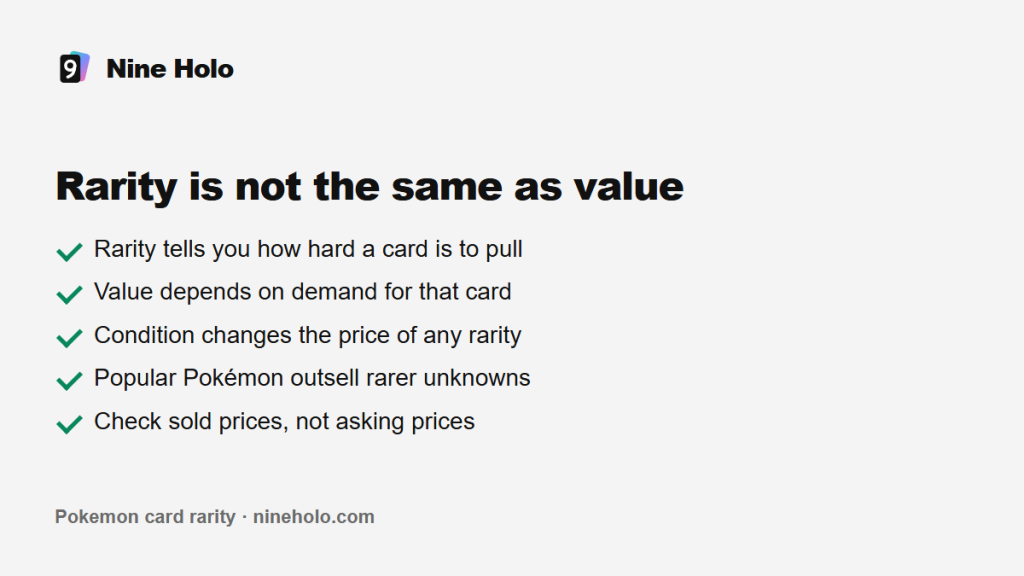
It is tempting to assume that the rarest card is the most valuable, but Pokémon card rarity only tells you about supply. Price depends on demand as well.
- The Pokémon matters. Cards of the most popular Pokémon regularly outsell rarer cards of less popular ones.
- The artwork matters. A well-loved illustration can lift a card far above others of the same rarity.
- Playability matters. Cards that are strong in the game are in demand from players, at least while they remain legal for tournaments.
- Condition matters. A worn copy of a rare card can be worth less than a perfect copy of a more common one. Our guide to the PSA grading scale explains how condition is measured.
- Age and print run matter. Older sets had smaller print runs and fewer copies have survived in good condition.
When you want to know what a card is worth, look at recent sold prices for that exact card in that condition. Asking prices tell you what sellers hope for; sold prices tell you what buyers paid.
How to check a card you are unsure about
If the symbol on a card does not match anything in this guide, there are two quick ways to settle it. First, identify the set. The set code and collector number in the bottom corner tell you which release the card belongs to. Second, look the card up. The official Pokémon Trading Card Game site has a searchable database of English cards, and each entry shows the card as it was printed.
Every set also has its own mix. Special sets, sometimes called holiday or subset releases, are sold only in boxes and collections rather than as loose booster boxes, and they often add their own shiny or gallery cards on top of the usual Pokémon card rarity levels. Knowing which set you are looking at explains most surprises.
Finally, remember that printing changes over time. The meaning of a star in a set from the late 1990s is not the same as its meaning today, so always read Pokémon card rarity together with the era, the card type and the collector number. A grading company such as PSA lists the full name and variety of a card on its label, which is another useful reference when you are comparing an unusual card with known examples.
How to sort a pile of cards by rarity
If you have a box of mixed cards, Pokémon card rarity gives you a quick and reliable sorting method.
- Check the collector number first. Any card numbered above the set size goes straight into the “look closer” pile.
- Pull out anything with gold or silver stars, a promo star, full-card artwork or texture.
- Set aside holographic rares, especially from older sets.
- Separate reverse holos from plain cards.
- Group the remaining stars, diamonds and circles together as bulk.
Sleeve the cards in the first three groups as you go. The cards most likely to be valuable are also the ones most easily damaged, and our trading card storage guide explains how to protect them. Be alert for counterfeits too, particularly in lots bought second-hand: our guide to fake Pokémon cards lists the checks to make.
Frequently asked questions
What is the rarest Pokémon card rarity?
Among cards pulled from modern English packs, special illustration rares and hyper rares are the hardest to find. Across the whole hobby, the rarest cards are prize and trophy promos given out in tiny numbers.
Is a star always a rare card?
A black star means rare, but in older sets the same star appears on cards that range from ordinary rares to very scarce ultra rares. Use the card type and the collector number as well.
Are holo cards always rare?
Traditional holos are rares. Reverse holos are not necessarily rare, because commons and uncommons are printed as reverse holos too.
What does a number higher than the set size mean?
It means the card is a secret rare, numbered beyond the official set count. It is one of the simplest signs of high Pokémon card rarity.
Do Energy cards have rarity?
Basic Energy cards usually carry no rarity symbol. Special Energy cards have one, and some Energy cards are printed as high-rarity gold cards.
The short version
Pokémon card rarity is shown by a small symbol in the bottom corner. A circle is common, a diamond is uncommon and a star is rare. Modern sets add two black stars for double rares, two silver stars for ultra rares, and one, two or three gold stars for illustration rares, special illustration rares and hyper rares. A collector number higher than the set size means a secret rare, and a star marked PROMO means a promotional card. Rarity tells you how hard a card is to pull; demand and condition decide what it is worth.
Ready to look for some? Browse all Pokémon cards in our shop, from sealed boxes to graded singles.