Collecting Pokémon Cards: 10 Proven Steps for Smart Beginners
Collecting Pokémon cards is one of the most popular hobbies in the world, and one of the easiest to start. You can begin with a single booster pack, and there is no right or wrong way to do it. That freedom is also what makes the first few weeks confusing. There are hundreds of sets, a dozen kinds of sealed product, strange words like “illustration rare” and “PSA 10”, and prices that range from pocket money to the cost of a car.
This guide breaks collecting Pokémon cards into ten clear steps. It explains how to decide what to collect, what the different products are, when to open packs and when to buy single cards, how to protect what you own, and how to avoid the mistakes that cost beginners the most money. It is written for adults starting or returning to the hobby, and for parents helping a child.
Nothing here requires a big budget. The most important decisions when collecting Pokémon cards are about focus and care, not spending.
In this guide
Why collecting Pokémon cards is so popular
Part of the appeal is simple: the cards are beautiful, and the characters are known and loved across generations. Many adults collecting Pokémon cards today first opened packs as children, and are now returning with their own money or with children of their own.
Part of it is the structure. Sets have a fixed list of cards, so there is always a clear goal and a sense of progress. There is the fun of opening a pack without knowing what is inside. There is a real game to play, with local leagues and tournaments. And there is a large, active community, which means cards are easy to buy, sell and trade.
It helps to be honest about one thing from the start. Some cards rise in value and many do not. Collecting Pokémon cards is best treated as a hobby you enjoy, with any increase in value as a bonus rather than the plan.
1. Decide what kind of collector you are
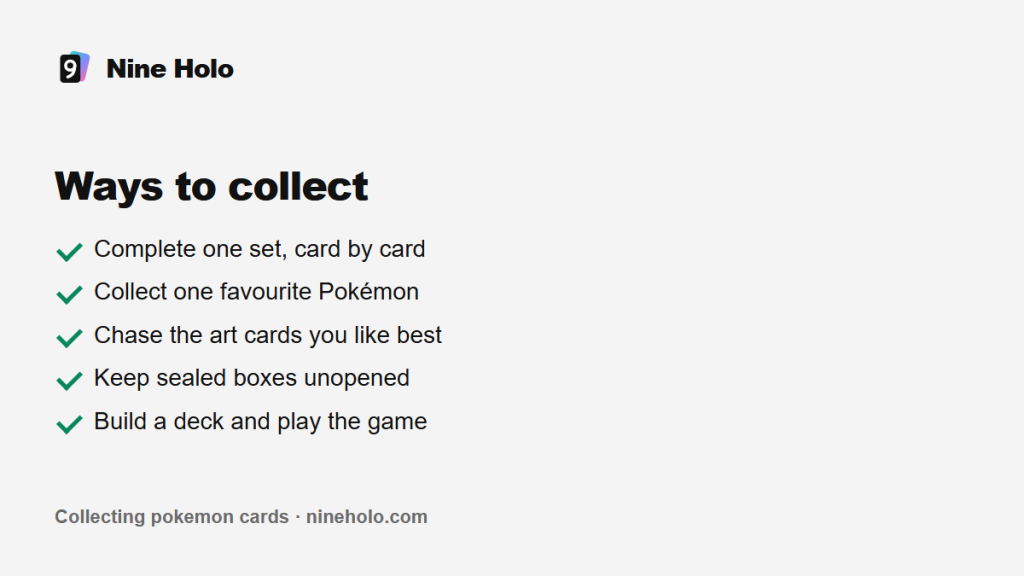
The fastest way to waste money when collecting Pokémon cards is to buy a little of everything. A collection with a theme is more satisfying and much cheaper to build. Common approaches include:
- Set collecting. Choose one set and try to complete it, either the main numbered set or the “master set” that includes every version of every card.
- Pokémon collecting. Collect every card of one favourite Pokémon, across all sets and years.
- Art collecting. Collect the illustration cards you find most beautiful, or the work of one artist.
- Sealed collecting. Keep booster boxes, Elite Trainer Boxes and other products unopened.
- Vintage collecting. Focus on the earliest sets from the late 1990s and early 2000s.
- Playing. Build decks and play the trading card game, collecting the cards you need.
When collecting Pokémon cards you can change your mind later, and most people combine two or three of these. But picking one to start with gives every purchase a purpose.
2. Set a budget before you buy anything
Before collecting Pokémon cards in earnest, decide how much you are comfortable spending each month and keep to it. This sounds obvious, and it is the step most often skipped. Opening packs is exciting by design, and it is easy to buy “just one more” in the hope of a particular card.
A fixed budget turns collecting Pokémon cards into a series of choices rather than impulses. It also makes the hobby last. A modest amount spent steadily on cards you have chosen builds a better collection than a large amount spent in a burst.
If you are buying for a child, a budget is a useful lesson in itself: a set amount each month, and a decision together about how to use it.
3. Learn the main sealed products
Anyone collecting Pokémon cards soon notices that the same booster packs are sold in many kinds of packaging. Knowing the main ones saves you from paying more than you need to.
- Booster pack. A single pack of cards from one set, usually ten cards in English sets, with at least one rare card or better.
- Booster box. A display box of packs, 36 in a standard English main-set box. It is the cheapest way to buy packs in quantity. See our Pokémon booster boxes.
- Elite Trainer Box (ETB). A box with several booster packs plus card sleeves, dice, markers and a storage box. It is a very good first purchase. See our Elite Trainer Boxes.
- Booster bundle. Six packs in a small box with nothing else.
- Collection boxes and tins. A few packs with one or more promo cards and sometimes a figure, pin or oversized card.
- Starter and battle decks. Ready-to-play decks for learning the game.
Our guide to booster boxes compared with Elite Trainer Boxes and bundles sets out what each contains and who it suits.
4. Understand rarity before you open packs
Every card has a small symbol in the bottom corner showing how rare it is. A circle means common, a diamond means uncommon and a star means rare. Modern sets add further marks for the special cards: two black stars for a double rare, two silver stars for an ultra rare, and gold stars for the illustration rares, special illustration rares and hyper rares that most collectors hope to pull.
Understanding rarity changes how you see a pack, and it is one of the first skills in collecting Pokémon cards. Most of the cards in any pack are commons and uncommons, and that is normal. The special cards are scarce by design. Our guide to Pokémon card rarity explains every symbol and shows how to sort a pile of cards quickly.
5. Know when to buy singles instead of packs
This is the single most useful piece of advice for anyone collecting Pokémon cards: if you want a specific card, buy that card. Opening packs to find one particular card is almost always the most expensive way to get it, because the chance of pulling any one high-rarity card is small.
Open packs because you enjoy opening packs, and because you want a spread of cards from a set. Buy single cards to fill gaps and to get the cards you care about most. Most experienced collectors do both: a box or a few packs of a new set for the fun of it, then singles to finish.
You can browse Pokémon single cards and graded singles in our shop.
6. Protect your cards from the first day
When collecting Pokémon cards, remember that a card’s condition decides much of its value, and condition is lost in seconds: a scratch from sliding across a table, a soft corner from a pocket. Protecting cards costs very little and should begin with the first pack you open.
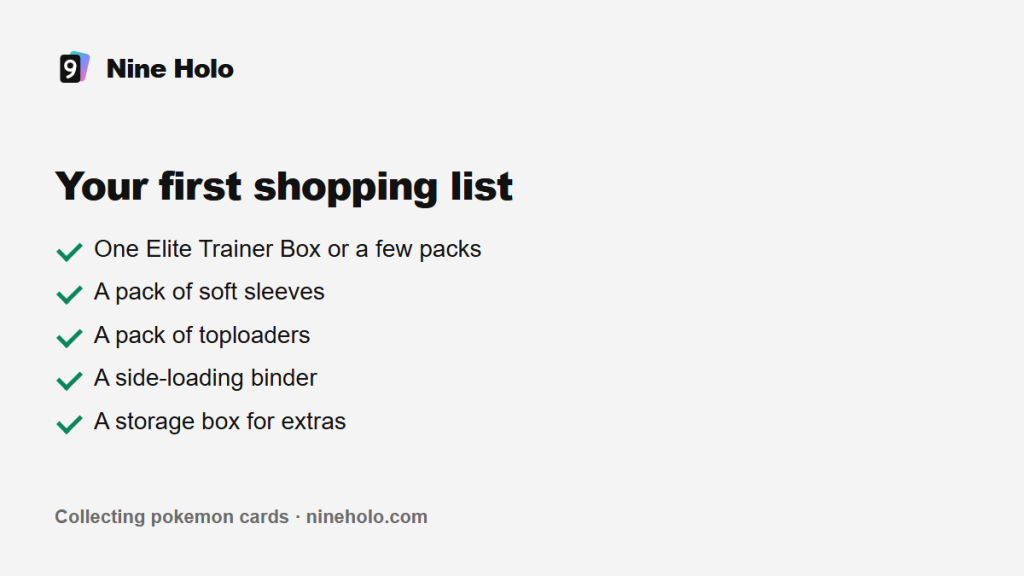
- Put any holographic or special card into a soft sleeve as soon as it leaves the pack.
- Put valuable cards, sleeved, into a rigid toploader.
- Keep a set in a binder with side-loading, PVC-free pages.
- Store spare commons upright in a card storage box.
- Keep everything away from sunlight, damp and heat.
Our full trading card storage guide goes through each of these in detail.
7. Learn the basics of card condition
When you buy single cards, the listing will describe the condition: Near Mint, Lightly Played, Moderately Played and so on. These words affect the price considerably. A Near Mint card looks unplayed; a Lightly Played card has minor wear; a Moderately Played card has obvious wear but is sound.
For a binder collection, Lightly Played cards are often the best value, because the wear is hard to see and the saving is real. For cards you may one day have graded, only Near Mint is worth considering. Our card condition guide explains each term and how to inspect a card yourself.
8. Learn to spot fakes
Counterfeit cards are common, and people who are new to collecting Pokémon cards are the main target. The most frequent traps are boxes of shiny “gold” cards sold for a few dollars, booster packs at a fraction of the normal price, and online lots promising large numbers of rare cards.
A few quick checks catch nearly all of them: compare the back of the card with one you know is real, read the text for spelling mistakes, feel the card stock and shine a light through it. Our guide to fake Pokémon cards lists eleven checks and the warning signs to look for in a listing. Until you are confident, buy from sellers who show the actual item and accept returns.
9. Decide whether grading is for you
Grading means sending a card to a company such as PSA, Beckett or CGC, which confirms the card is genuine, scores its condition out of ten and seals it in a hard plastic case. Graded cards are easier to sell and well protected, and high grades command a premium.
Grading costs money per card and takes time, so it is not for every card. It makes sense for valuable cards in excellent condition, and for cards you want preserved for their own sake. Many people collecting Pokémon cards never grade anything, and that is perfectly reasonable. If you are curious, our explanation of the PSA grading scale shows what each grade means, and you can also buy cards that are already graded.
10. Keep track of what you own
After a few months of collecting Pokémon cards, a collection passes a few hundred cards and it becomes hard to remember what you have. A simple record prevents you from buying duplicates and shows your progress towards a set. A spreadsheet works well, and there are free apps that let you tick off cards set by set.
Record the card, the set, the condition and what you paid. For anything valuable, add a photograph. If the collection becomes worth a significant amount, check whether your home insurance covers it, as many policies limit cover for collectibles unless they are declared.
What should you buy first?
For most people who are new to collecting Pokémon cards, an Elite Trainer Box from a current set is the best first purchase. It gives you several packs to open, sleeves to protect the good cards, and a sturdy box to keep everything in. Add a pack of toploaders and a side-loading binder, and you have everything you need.
If you already know you want to complete a set, a booster box is better value per pack. If you mainly want one or two favourite cards, skip the packs and buy those cards directly. And if you want to learn the game, begin with a ready-made deck, which contains everything needed to play. The official Pokémon Trading Card Game site has the rules and a guide to learning them.
How sets and eras fit together
One thing that confuses people who are new to collecting Pokémon cards is the sheer number of sets. It helps to know that sets are grouped into series, often called eras, each tied to a generation of the video games. Recent eras include Sun & Moon, Sword & Shield and Scarlet & Violet, with a newer series following. Within an era, a new main set arrives every few months, and special sets appear in between.
Each era has its own card design and its own feature cards, such as Pokémon V in Sword & Shield and Pokémon ex in Scarlet & Violet. Cards from the newest sets are legal in official tournaments; older ones rotate out over time. For collectors that does not matter, but it explains why some cards that are popular with players lose value when they leave the tournament format.
You do not need to follow every release. Most people collecting Pokémon cards choose a set or two from the current era, and perhaps one older set they remember fondly. Older sets that are no longer printed cost more to open, because sealed product becomes scarcer every year, so for those sets single cards are usually the sensible route.
Where to trade and meet other collectors
Collecting Pokémon cards is more enjoyable with other people. Local game shops often run league nights where players and collectors meet, trade and learn the game, and many towns have card shows where dealers and collectors gather for a day. Online, there are active communities for every kind of collector, from set builders to fans of a single Pokémon.
Trading is a good way to turn duplicates into cards you need. Keep it fair by checking recent sold prices for both sides of a trade, and do not feel pressed to agree on the spot. Take the same care with authenticity when trading as when buying. For meeting people in person, stick to public places such as shops and organised events.
Collecting Pokémon cards with children
Children collect differently from adults, and that is fine. They want to handle their cards, trade them, sort them and show them to friends. Trying to keep a child’s collection in perfect condition usually removes the fun.
A sensible compromise is two tiers. Give the child a binder and a box for cards they can handle freely. Agree that the few genuinely special cards go into a sleeve and toploader and are kept somewhere safe. Teach them to hold cards by the edges and to keep drinks away from the table, and leave it at that.
Be careful with trading at school. Children do not always understand value, and unfair trades cause upset. A simple rule, such as checking with a parent before trading any card kept in a toploader, prevents most problems.
Common mistakes when collecting Pokémon cards
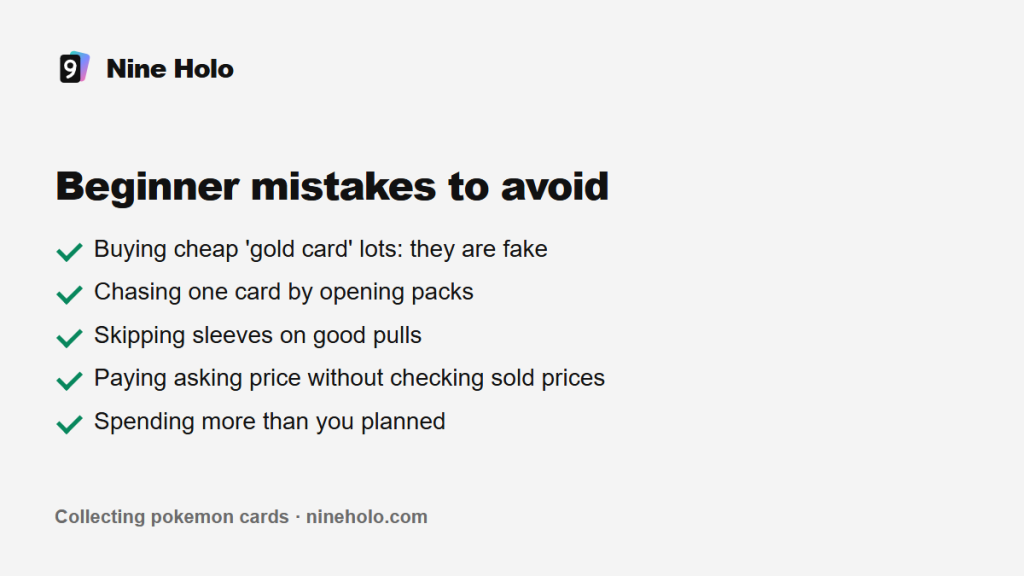
- Buying without a focus. A little of everything costs a lot and satisfies little.
- Chasing a card through packs. Buy the single instead.
- Falling for fakes. If the price looks too good, it is.
- Leaving good cards unsleeved. Damage is permanent.
- Trusting asking prices. Look at what cards have actually sold for.
- Treating it as an investment. Prices fall as well as rise. Buy what you would be happy to keep.
- Buying every new release. New sets arrive several times a year. You do not need them all.
Frequently asked questions
How much does it cost to start collecting Pokémon cards?
Very little. A few booster packs or one Elite Trainer Box, plus sleeves and a binder, is enough to begin. What you spend after that is up to you.
Are Pokémon cards a good investment?
Some cards have risen sharply in value, but many have not, and prices can fall. Collect what you enjoy and do not spend money you cannot afford to lose.
Should I open my packs or keep them sealed?
Either is a valid way of collecting Pokémon cards. Sealed product can hold or gain value over time, but opening packs is where most of the enjoyment is. Many collectors buy two of something: one to open and one to keep.
Are English or Japanese cards better?
Neither is better. English cards have the larger market outside Japan. Japanese cards are known for print quality and often release sets earlier. Collect whichever you prefer.
Where should I buy?
From sellers who show the actual product, state condition clearly and are easy to contact. You can browse all Pokémon cards in our shop.
The short version
Collecting Pokémon cards works best with a plan. Decide what you want to collect, set a monthly budget, learn the main products and the rarity symbols, open packs for fun and buy singles for the cards you really want. Sleeve good cards immediately, learn the condition terms, watch for fakes, and keep a simple record of what you own. Do that, and collecting Pokémon cards will stay enjoyable and affordable for years.