Card Condition Guide: 6 Essential Grades From Near Mint to Damaged
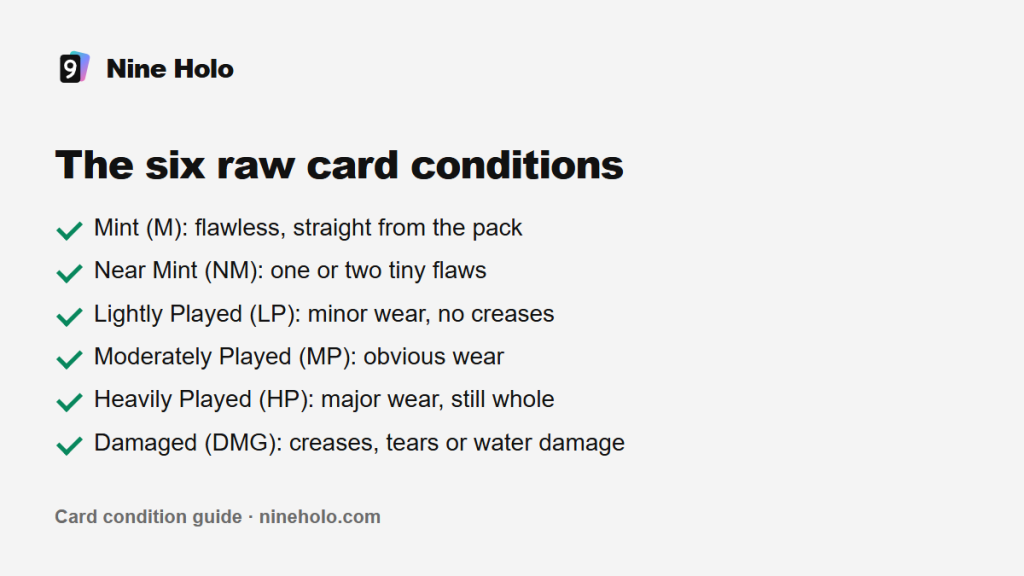
This card condition guide explains the words that buyers and sellers use to describe raw trading cards: Mint, Near Mint, Lightly Played, Moderately Played, Heavily Played and Damaged. These terms appear on almost every listing for an ungraded card, and they have a real effect on price. A card described as Near Mint can cost twice as much as the same card described as Moderately Played.
Unlike graded cards, which are assessed by a grading company and sealed in a slab, raw cards are described by whoever is selling them. That makes it essential to know what each term should mean, how to inspect a card yourself, and where honest sellers and optimistic sellers tend to disagree. This card condition guide gives you a shared standard to work from, whether you are buying one card or sorting a collection of thousands.
The same six conditions are used across Pokémon, Magic: The Gathering, Yu-Gi-Oh!, One Piece and most other trading card games. Sports cards more often use the vocabulary of the grading companies, but the underlying ideas are identical.
In this guide
Why a card condition guide matters
Condition is one of the three things that decide what a card is worth, alongside which card it is and how many people want it. It is also the one most open to disagreement. Everyone can agree on a card’s name and number. Not everyone agrees on whether a faint scratch makes a card Lightly Played.
A clear card condition guide solves two problems. As a buyer, it tells you what you should receive for the price you paid, and gives you a fair basis for a complaint if the card that arrives is worse than described. As a seller, it helps you describe cards accurately, which means fewer returns, fewer disputes and better feedback.
It also helps with expectations. Many people assume that a card kept in a binder since childhood must be in perfect condition. In practice, most such cards are Lightly or Moderately Played, and knowing that in advance prevents disappointment.
The four things every card condition guide looks at
Every condition in this card condition guide is judged on the same four areas. These are the same areas the grading companies examine.
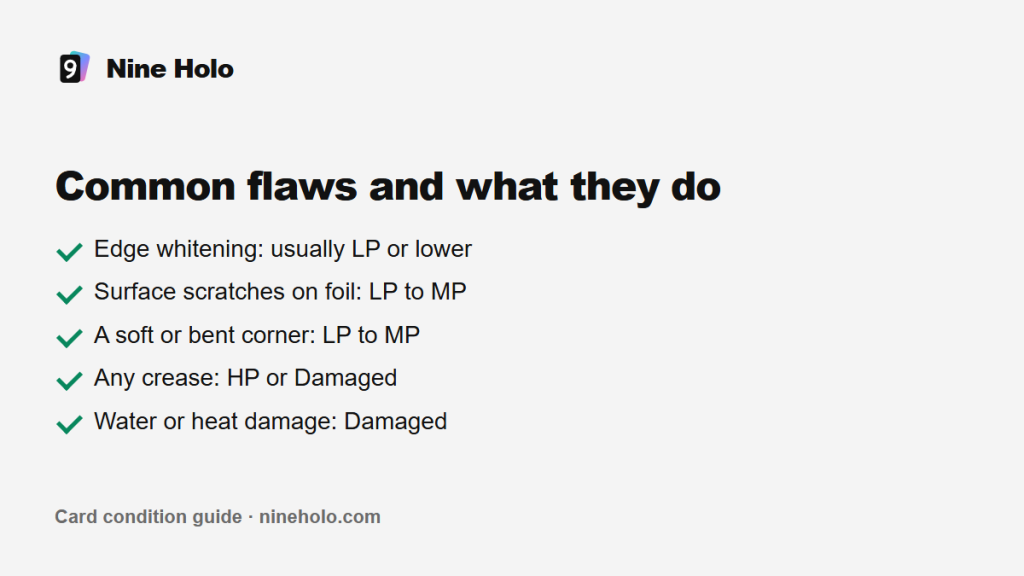
- Corners. Are they sharp, or have they gone soft, rounded, bent or frayed?
- Edges. Is there whitening, where the coloured layer has worn off and the pale card stock shows through? Are there nicks or chips?
- Surface. Are there scratches, scuffs, dents, print lines, stains, clouding or loss of gloss? Foil surfaces show marks more readily than plain ones.
- Shape and structure. Is the card flat? Are there bends, creases, tears, peeling or signs of water damage?
Centering, meaning how evenly the image sits within its borders, matters greatly for graded cards but is not usually part of raw condition terms. A badly off-centre card can still be Near Mint, though a careful seller will mention it.
1. Mint (M)
In any card condition guide, a Mint card is flawless. It has four sharp corners, clean edges with no whitening at all, a perfect surface and full gloss. It looks exactly as a card should when it leaves the factory in ideal condition.
True Mint cards are less common than you might think, because cards frequently come out of the pack with small factory flaws: a faint print line, a tiny nick on an edge, a speck of whitening on a back corner. For that reason, many careful sellers avoid the word Mint altogether and use Near Mint as their top grade for raw cards. Treat a raw card advertised as Mint with polite caution and ask for close photographs.
2. Near Mint (NM)
In this card condition guide, Near Mint is the standard top condition for raw cards, and the one most price guides use as their baseline. A Near Mint card looks unplayed. On close inspection it may show one or two very minor imperfections: a tiny speck of whitening on one or two back corners, a very faint surface scratch visible only when the card is tilted under strong light, or a slight factory print flaw.
What Near Mint must not have is anything you can see at arm’s length. There should be no whitening along the full length of an edge, no soft corners, no scuffing, no dents and certainly no bends or creases. If you have to wonder whether a flaw is acceptable in a Near Mint card, the card is probably Lightly Played.
3. Lightly Played (LP)
The third step in the card condition guide is Lightly Played. A Lightly Played card shows minor wear that is noticeable on inspection but does not spoil the look of the card. Typical signs are light whitening on several corners or along parts of the edges, a few light surface scratches, or slight scuffing. The card may have been played without sleeves a handful of times, or carefully kept in a binder for years.
There should still be no creases, no bends that have left a visible line, and no major scratches. Lightly Played is the condition where you find the best value if you want a card that looks good in a binder without paying the Near Mint price. On a card with a dark border or a busy holographic pattern, light wear can be very hard to spot from the front.
4. Moderately Played (MP)
The fourth step in the card condition guide is Moderately Played. A Moderately Played card has wear that is obvious as soon as you look at it. Expect whitening around most of the border, corners that are visibly rounded or soft, scratches and scuffing on the surface, and possibly light dirt or minor indentations. There may be a small, light bend or a very minor crease that does not break the surface badly.
The card is still structurally sound. It is complete, it lies reasonably flat, and it is perfectly usable in a sleeved deck. Moderately Played cards suit players who care about function rather than appearance, and collectors who want an affordable copy of an expensive older card.
5. Heavily Played (HP)
The fifth step in the card condition guide is Heavily Played. A Heavily Played card shows major wear all over. Whitening is heavy on every edge, the corners are rounded or frayed, the surface is scratched and scuffed, and there may be creases, dirt, discolouration or light peeling. The card has clearly had a long and active life.
Even so, a Heavily Played card is still whole and, once sleeved, still legal to play with in most settings, because the wear does not make it identifiable from the back through an opaque sleeve. This condition is mainly of interest for very expensive cards, where a worn copy is the only affordable way to own one.
6. Damaged (DMG)
Damaged is the lowest step in this card condition guide. It covers cards with structural problems: deep creases, tears, holes, missing pieces, water damage, warping from heat, peeling layers, heavy staining, or writing and stickers on the card. A card can also be listed as Damaged because it has been altered, for example trimmed or recoloured.
Damaged cards are generally not suitable for tournament play even in a sleeve, and their value is a small fraction of a Near Mint copy. They still have a place, as inexpensive placeholders in a set or as the only reachable copy of a famous card.
How to use a card condition guide to inspect a card
Using this card condition guide well depends on looking at the card the right way. Most disagreements about condition come from a quick glance under poor light.
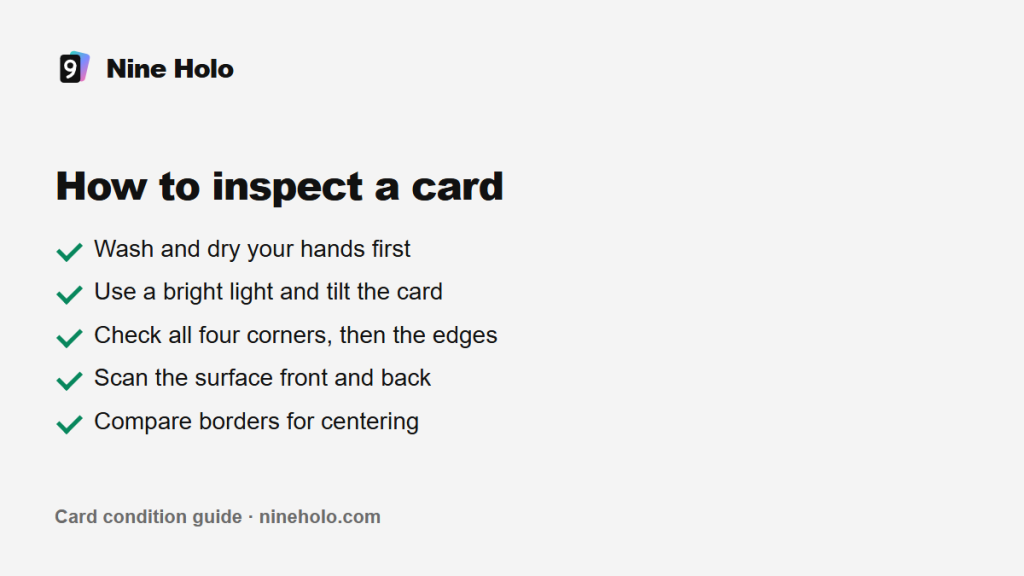
- Clean hands. Wash and dry your hands, and hold the card by its edges.
- Good light. Use a bright lamp or daylight. A dim room hides scratches and whitening.
- Tilt the card. Surface scratches and dents appear and disappear as the angle changes. Rotate the card slowly under the light.
- Check the back first. Wear shows most clearly on the back, where the dark border makes whitening stand out.
- Go corner by corner. Look at each of the eight corners, front and back, then run your eye along each edge.
- Take it out of the sleeve. Sleeves and toploaders have their own scratches, which can hide or mimic flaws on the card.
- Use magnification for expensive cards. A loupe or a phone camera on zoom reveals things the eye misses.
The golden rule of any card condition guide is this: when in doubt, grade down. A buyer who receives a card in better condition than described is pleased. A buyer who receives one in worse condition asks for a refund.
Flaws that are easy to miss
Some problems hide well, and no card condition guide is useful if you miss them. Knowing where to look saves you from the most common surprises.
- Light bends. A card can have a gentle bend that only shows as a line when light crosses it at the right angle.
- Indentations. Small dents from a fingernail or from something pressed on top of the card may be invisible from the front and obvious from the back.
- Foil scratches. Holographic surfaces can look perfect face-on and scratched when tilted.
- Clouding. Foil cards stored badly can develop a hazy patch on the surface.
- Curling. Foil cards often curve slightly with changes in humidity. A light curl is not usually counted against condition, but a severe warp is.
- Factory flaws. Print lines, roller marks and rough-cut edges come from manufacturing, not handling. They still affect how a card should be described, and they matter if you plan to have it graded.
How condition changes the price
A card condition guide cannot give you a fixed formula for price, but the pattern is consistent. Near Mint is the reference price. Lightly Played copies usually sell at a modest discount. Moderately Played copies sell for noticeably less, Heavily Played copies for much less, and Damaged copies for a small fraction.
The size of the discount depends on the card. For inexpensive, widely available cards, condition makes little difference because buyers simply choose a Near Mint copy. For older and scarcer cards, where clean copies are hard to find, the gap between conditions grows wide, and even Heavily Played copies hold real value.
When you compare prices, always compare the same condition. A card that looks like a bargain is often just one step lower on the card condition guide than the listing next to it.
How a card condition guide compares with graded numbers
Raw condition terms and grading company numbers describe the same thing in different ways, and people naturally want to translate between them. Treat any translation as rough. A grading company examines a card under magnification against a detailed written standard, and it also measures centering, which raw terms ignore.
As a loose guide, a genuinely Near Mint raw card might grade anywhere from about 7 to 9 on a ten-point scale, and occasionally higher; a Lightly Played card might land around 5 to 7; a Moderately Played card lower still. The spread is wide because small flaws that are acceptable in a raw description can cost a full grade or more. Our explanation of the PSA grading scale describes what each number requires, and our guide to PSA and BGS grading compares the two main companies.
If the exact condition matters to you, because the card is expensive or you want certainty, a graded copy removes the argument. You can browse authenticated cards in our graded cards section, or look at raw Pokémon single cards.
Card condition guide advice for buyers
- Read the stated condition and then look at the photographs, front and back. If there are no photographs of the actual card, ask for them.
- Ask direct questions about anything you cannot see: “Are there any creases, bends or dents?” gets a clearer answer than “What condition is it in?”
- Check the seller’s returns policy before you pay.
- When the card arrives, inspect it promptly using the steps above, and raise any problem straight away with photographs.
- Be realistic. A Lightly Played card is supposed to have light wear.
Card condition guide advice for sellers
- Describe the worst flaw, not the average. One crease makes a card Heavily Played or Damaged, however clean the rest is.
- Photograph the actual card in good light, front and back, with close-ups of any flaws.
- Mention factory flaws and poor centering even though they are not strictly part of the condition term.
- If a card sits between two conditions, choose the lower.
- Pack cards so they arrive in the condition you described.
How different sellers use a card condition guide
There is no single official card condition guide for raw cards. Large marketplaces publish their own, and individual shops often follow one of those or write their own version. The six steps are nearly universal, but the boundaries between them move a little from seller to seller. One shop’s Near Mint may allow slightly more whitening than another’s, and some sellers add in-between steps such as “Excellent” or “Near Mint-Mint”.
That is why it pays to read the card condition guide of the place you are buying from, rather than assuming the words mean exactly what they meant elsewhere. Grading companies such as PSA and Beckett publish detailed written standards for their numerical grades, and those are a useful reference when you want to understand how strictly a flaw is normally treated.
Language and region matter too. Japanese sellers commonly use letter ranks, with A for the best condition and lower letters for more wear, and sports card sellers often borrow grading terms such as Excellent or Very Good for raw cards. Whatever the wording, the same card condition guide logic applies: look at corners, edges, surface and shape, and judge by the worst flaw.
Keeping cards in the condition they are in
However carefully you apply a card condition guide, condition only ever moves in one direction. A Near Mint card becomes Lightly Played through handling, play without sleeves, sliding in and out of binder pages and poor storage. Sleeve anything you care about, use rigid holders for valuable cards, and keep the collection somewhere with steady temperature and humidity, out of direct light. Our trading card storage guide goes through each step.
The same care applies when buying collections second-hand. Check condition carefully, and check authenticity as well: our guide to fake Pokémon cards covers the signs.
Frequently asked questions
Is Near Mint the same as Mint?
No. Mint means flawless. Near Mint allows one or two very small imperfections that are only visible on close inspection. Many sellers use Near Mint as their best raw condition.
Does a crease always mean Damaged?
A crease always lowers a card to Heavily Played at best. A deep crease that breaks the surface or runs across the card usually means Damaged.
Are pack-fresh cards always Near Mint?
Usually, but not always. Factory flaws such as print lines and edge nicks are common, so check even cards you opened yourself.
Does off-centre printing lower the condition?
Not in raw terms. Centering is a grading factor rather than a wear factor, though it should be mentioned in a listing and it will affect a graded result.
Which condition is the best value?
For most collectors, Lightly Played. The discount is real and the wear is hard to see in a binder or a sleeve.
The short version
This card condition guide comes down to six steps. Mint is flawless. Near Mint looks unplayed with at most a couple of tiny flaws. Lightly Played has minor wear and no creases. Moderately Played has obvious wear but is sound. Heavily Played is worn all over but whole. Damaged has structural problems. Inspect corners, edges, surface and shape under good light, grade down when unsure, and compare prices only between cards in the same condition.
When you are ready to buy, you can browse every listing in our shop, where the condition is stated on each product.