
Shipping Trading Cards: 8 Proven Steps to Avoid Damage
Shipping trading cards is where a lot of good cards meet a bad end. A card can survive twenty years in a binder and be ruined in two days in the post, bent by a sorting machine, soaked by rain on a doorstep or cracked by another parcel landing on top of it. Almost all of that damage is preventable, and preventing it costs very little.
This guide covers shipping trading cards in eight proven steps, from a single card in an envelope to graded slabs and sealed booster boxes. It explains what materials to use, how to pack each kind of item, when tracking and insurance are worth paying for, and what to do when you are the one receiving a parcel. The methods are the ones experienced sellers use every day, and they apply to Pokémon, sports cards, One Piece and every other kind of card.
The principle behind all of it is simple. A card in transit needs to be protected from three things: bending, moisture and movement. Every step below deals with one of those.
In this guide
Why shipping trading cards needs care
Postal systems are built for speed, not gentleness. Letters and small parcels pass through rollers and belts, travel in sacks with heavier items, and are handled many times. A plain envelope offers a card no protection against any of that.
The cost of getting it wrong is larger than the price of the card. A buyer who receives a damaged card asks for a refund, the card itself is now worth less, and the seller’s reputation suffers. For buyers, a card that arrives damaged is a disappointment even when the money comes back, because the card you wanted is gone. Careful packing when shipping trading cards avoids all of this for the price of a sleeve, a toploader and a few minutes.
What you need for shipping trading cards
The supplies for shipping trading cards are not expensive, and most are sold in bulk.
- Soft sleeves, often called penny sleeves, to protect the surface.
- Toploaders or semi-rigid holders, to stop bending.
- Team bags, resealable clear bags sized to hold a toploader, to keep out dust and moisture.
- Cardboard, cut slightly larger than the toploader, for a rigid sandwich.
- Painter’s tape or another low-tack tape, which peels off cleanly.
- Bubble mailers for single cards and small orders.
- Small boxes for larger orders, slabs and sealed product.
- Padding: bubble wrap, packing paper or air pillows.
- Strong parcel tape for sealing the outside.
Clean, recycled cardboard and boxes are perfectly acceptable, as long as they are dry, rigid and free of old labels and barcodes that might confuse a sorting machine.
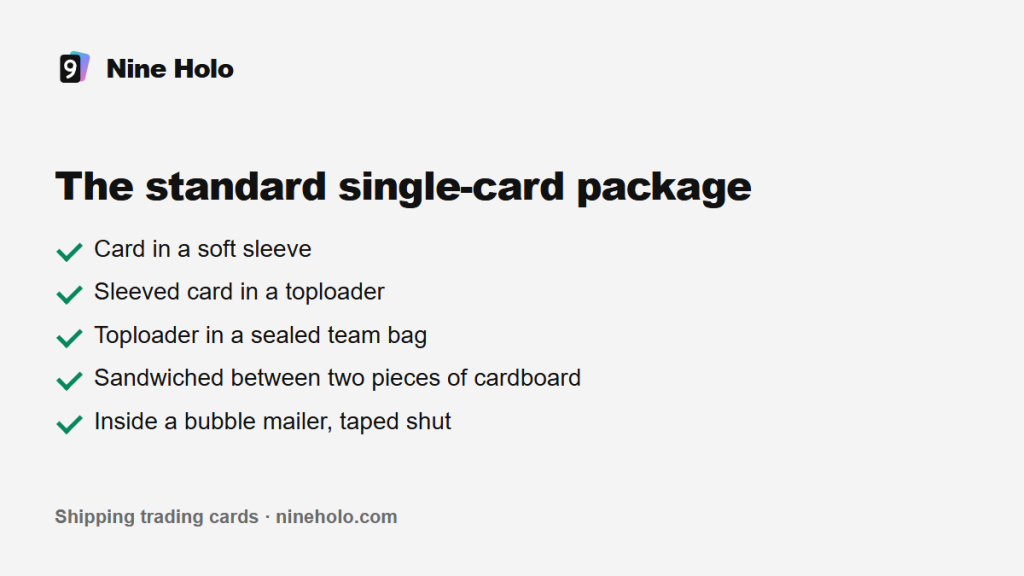
1. Sleeve the card
The first step in shipping trading cards is always a soft sleeve. A sleeve stops the card’s surface rubbing against the inside of the hard holder, which can scratch a glossy or holographic finish. Hold the card by its edges and slide it in from the top without forcing it.
When shipping trading cards, never put a bare card into a toploader. It is the most common beginner mistake, and the scratches it causes are permanent.
2. Put it in a rigid holder
The second step in shipping trading cards is rigidity. Slide the sleeved card into a toploader or a semi-rigid holder. This is the layer that resists bending. Use a holder of the right thickness: a standard toploader for normal cards, and a thicker one for memorabilia or patch cards, so that the card is neither loose nor squeezed.
If you are sending several cards, you can put a small number of sleeved cards into one toploader only if they fit without pressure. For anything valuable, give each card its own holder.
3. Seal it in a team bag
The third step in shipping trading cards is sealing. Place the loaded toploader in a team bag and seal the flap. The bag does two jobs. It stops the card sliding out of the open top of the toploader, and it gives a first barrier against rain and humidity.
If you do not have team bags, close the top of the toploader with a small piece of painter’s tape, folded over at one end to make a pull tab. Do not use ordinary clear tape or parcel tape on a toploader. It leaves residue, it is hard to remove, and buyers have damaged cards trying to cut it off. Whatever you use, the tape must never touch the card or the sleeve.
4. Make a cardboard sandwich
The fourth step in shipping trading cards adds stiffness. A toploader is stiff, but it can still be bent by a determined machine. Place the bagged toploader between two pieces of cardboard that are a little larger than the toploader on every side, and tape the sandwich together around the edges so that the card cannot slide out.
The extra margin matters. If the cardboard is larger than the toploader, any knock to an edge hits the cardboard first rather than the card’s corner. For extra stiffness, turn the two pieces so that the corrugations run in different directions.
5. Choose the right mailer or box
The fifth step in shipping trading cards is the outer packaging, which depends on what you are sending and what it is worth.
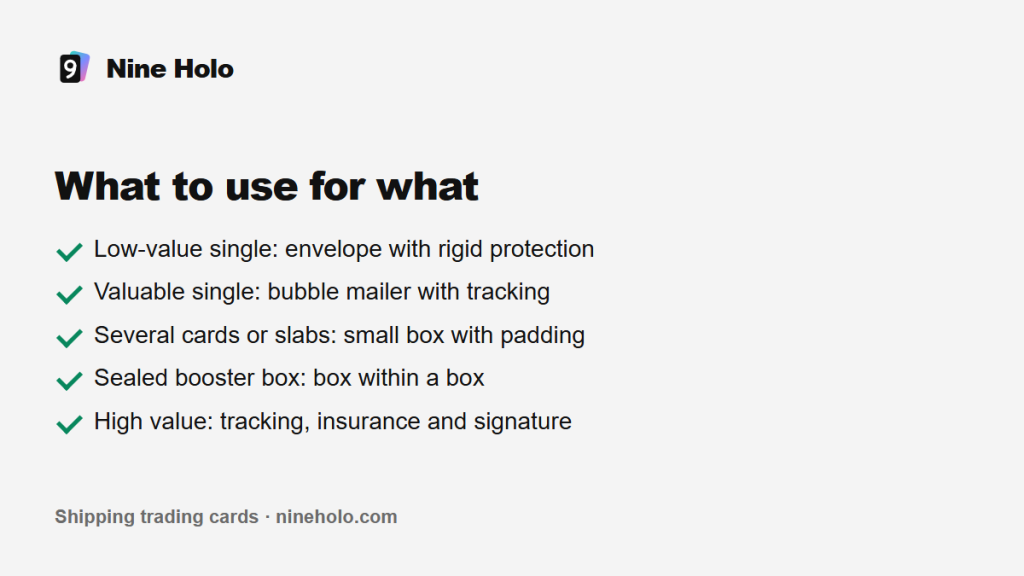
- Plain envelope. Only for low-value cards, and only with rigid protection inside. Many postal services charge extra for, or refuse, rigid items sent at letter rates, and letters are usually untracked and uninsured. Treat this as a budget option where both sides accept the risk.
- Bubble mailer. The standard choice for one to a few cards. The cardboard sandwich goes inside, and the mailer adds cushioning and some water resistance.
- Small box. The right choice for larger orders, graded slabs, valuable cards and all sealed product. A box cannot be bent, and it survives weight on top of it.
When in doubt, go one step up. The difference in postage between a mailer and a small box is usually small compared with the value of what is inside.
6. Stop anything from moving
The sixth step in shipping trading cards is to stop movement, because movement inside the package causes damage. Before sealing, give the package a gentle shake. If you can feel or hear the contents shift, add padding until you cannot.
In a bubble mailer, the cardboard sandwich should be a snug fit. If the mailer is much larger than the contents, fold the spare material over and tape it down. In a box, surround the contents with padding on every side, including the top and bottom, so that nothing touches the walls of the box directly. Corners and edges are where impacts land.
7. Seal, label and waterproof
The seventh step in shipping trading cards is the outside of the parcel. Seal every opening with strong parcel tape. On a box, tape along all the seams, not only the middle one. Write or print the address clearly and cover a handwritten label with clear tape so that rain cannot make it run. Include a return address.
For anything valuable, add a waterproof layer inside: the team bag for single cards, or a sealed plastic bag around the contents of a box. Parcels are sometimes left outside, and cardboard does not keep water out for long. Writing “Do not bend” on a mailer does no harm, but do not rely on it. The packing must do the protecting.
8. Add tracking and insurance when it matters
The last step in shipping trading cards is choosing the service. Tracking shows where a parcel is and proves that it was delivered. Insurance pays out if it is lost or damaged. Both cost extra, and both are worth it once the contents pass the point where you would mind losing them.
A reasonable approach when shipping trading cards is to scale the service to the value. Inexpensive cards can go by the cheapest method that both sides accept. Anything of moderate value should be tracked. Valuable items should be tracked and insured for their full value, and the most valuable should also require a signature on delivery. Check the rules of the service you use: carriers such as USPS publish what each service covers, and some limit or exclude cover for collectibles, so read the terms before relying on them.
Photograph the item and the packing before you seal the parcel. If something goes wrong, those photographs are the evidence a claim needs.
Shipping trading cards that are graded
A graded card is sealed in a hard plastic slab by a company such as PSA or Beckett. The slab protects the card from bending, but the slab itself can crack or scratch, and a damaged case reduces the value even though the card is untouched.
- Put the slab in a fitted slab sleeve or a team bag to prevent scratches.
- Wrap it in bubble wrap, covering the corners.
- Use a box, not a mailer. A slab in a bubble mailer can crack under pressure.
- If you are sending several slabs, wrap each one separately so they cannot knock against each other, and stand them on their edges with padding between them.
- Fill the box so that nothing moves.
Graded cards are usually valuable enough to justify tracking and insurance as a matter of course. You can see how slabs are graded in our explanation of the PSA grading scale, and browse them in our graded cards section.
Shipping trading cards in sealed boxes
Sealed product needs its own approach, because its value depends on the packaging. A booster box, an Elite Trainer Box or a hobby box with torn shrink wrap or a crushed corner is worth less, even when every pack inside is perfect.
- Protect the wrap. Wrap the sealed box in bubble wrap or place it in a plastic bag first, so that nothing rubs against the factory shrink wrap.
- Use a box within a box. Never stick a label directly on the product and post it as it is. Put it inside a shipping box that is larger on every side.
- Pad every side. Leave room for padding all round, including above and below. Corners are the most vulnerable part.
- Do not overpack. Padding should hold the box still without pressing hard enough to dent it.
- Use a sturdy outer box. Thin cardboard collapses under other parcels.
If you are buying sealed product, it is reasonable to ask a seller how it will be packed. You can browse sealed booster boxes and Elite Trainer Boxes in our shop, and our guide to choosing between a booster box or singles explains what to check before you buy.
Shipping trading cards in bulk
Shipping trading cards in large quantities works differently. Sleeving hundreds of commons is not practical, and it is not needed.
Stack the cards neatly and wrap each stack tightly in paper or place it in a fitted plastic card box, so that the cards cannot fan out or slide. Do not use rubber bands directly on cards, because they dent the edges. Pack the stacks or card boxes into a sturdy shipping box, fill every gap with padding so that nothing moves, and tape all the seams. For very large lots, purpose-made cardboard card storage boxes fit neatly inside a shipping box and keep rows upright.
Shipping trading cards internationally
Shipping trading cards abroad adds time, handling and paperwork. Parcels travel further and are sorted more often, so pack one level more carefully than you would for domestic post, and use a box for anything of real value.
A customs declaration is normally required. Describe the contents honestly and state the true value. Under-declaring to reduce import charges is not allowed, and it also means any insurance claim will be limited to the declared amount. The recipient may have to pay import duty or tax on arrival, which varies by country, so it is best for buyer and seller to be clear about that in advance. Tracking is strongly recommended for international parcels, since delays are common.
What shipping trading cards should cost
Buyers and sellers both benefit from knowing roughly where the money goes. The cost of shipping trading cards has two parts: materials and postage.
Materials for a single card are very cheap. A sleeve, a toploader, a team bag, two pieces of cardboard and a bubble mailer together cost well under the price of a booster pack, and sellers who buy supplies in bulk pay less still. Boxes and padding for slabs or sealed product cost a little more, though clean recycled boxes work perfectly well.
Postage is the larger part and depends on weight, size, distance and service. An untracked letter is the cheapest. A tracked small parcel costs more, and insurance and signature on delivery add to that. Heavy sealed boxes cost more again because of their weight.
When you buy, a postage charge that seems high for one card often reflects tracking and proper packing rather than profit, and it is usually worth paying. When you sell, say clearly which service you use and how the card will be packed. Buyers are far more comfortable paying for shipping trading cards when they know what they are getting, and combining several cards into one parcel is an easy way to save both sides money.
What to do when a parcel arrives
Shipping trading cards is only half the journey. If you are the buyer, a few habits protect you.
- Look at the parcel before opening it. If it is visibly crushed, wet or torn, photograph it first.
- Open it carefully. Cut tape along the seams, away from the contents, and never slice through the middle of a mailer.
- Peel tape off toploaders slowly. Do not cut towards the card.
- Inspect the item promptly and compare it with the listing. Our card condition guide explains what each condition should look like.
- If there is a problem, contact the seller straight away with photographs of the packaging and the item, and keep everything until it is resolved.
Once the cards are safely out of the parcel, store them properly. Our trading card storage guide explains how.
Common mistakes when shipping trading cards
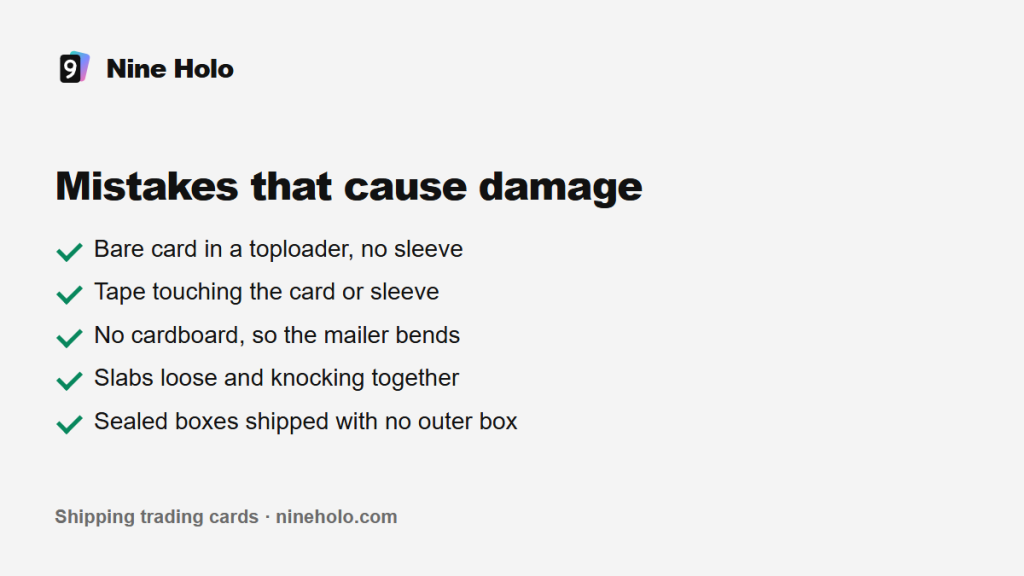
- A bare card in a toploader. Always sleeve first.
- Clear tape over the toploader opening. Use a team bag or painter’s tape.
- Tape touching the card. It can lift the surface when removed.
- No rigid protection. A bubble mailer on its own bends.
- Loose contents. Anything that can move will be damaged.
- Slabs in mailers. Cases crack under pressure.
- Sealed product with no outer box. Wrap and corners suffer.
- No tracking on valuable items. Without it, a lost parcel is one person’s word against another’s.
- Too much tape. A parcel that needs a knife and five minutes to open puts the contents at risk.
Frequently asked questions
What is the safest method for shipping trading cards?
Sleeve, toploader, sealed team bag, cardboard on both sides, and a bubble mailer or box with tracking. For slabs and sealed product, always use a box with padding on every side.
Can I send a card in a plain envelope?
Only for low-value cards, with rigid protection, and only where the postal service allows it. Envelopes are usually untracked and uninsured, so both sides should accept the risk.
Is painter’s tape really necessary?
It is the easy way to avoid residue and damage. It holds well enough for the journey and peels off cleanly. A sealed team bag removes the need for tape on the toploader at all.
When should I insure a parcel?
Whenever you would be unhappy to lose the contents. Check what the carrier’s cover includes, because some services limit or exclude collectibles.
How should I pack several cards together?
Give valuable cards their own toploaders, stack the toploaders, bag them together, sandwich the stack in cardboard and use a box if the stack is thick.
The short version
Shipping trading cards safely comes down to three protections: against bending, against moisture and against movement. Sleeve the card, put it in a rigid holder, seal it in a team bag, sandwich it in cardboard and post it in a bubble mailer, or a padded box for slabs and sealed product. Use low-tack tape, make sure nothing shifts inside, and add tracking and insurance in line with the value. Do that every time, and cards will arrive looking exactly as they did when they left.
Ready to add to your collection? Browse every listing in our shop.