One Piece Card Game: 8 Essential Things Smart Beginners Should Know
The One Piece Card Game has become one of the biggest trading card games in the world in only a few years. Published by Bandai and based on Eiichiro Oda’s manga and its anime, it combines a fast, tactical game with some of the most striking card artwork being printed today. If you have heard people talk about “OP-05” or “manga rares” and wondered what they meant, this guide is for you.
It covers eight essential things a beginner should know about the One Piece Card Game: what it is, how a game works, the card types and colours, the rarities, how sets and product codes are organised, what the sealed products contain, the difference between English and Japanese cards, and what to buy first. You do not need to know the story to enjoy the cards, though fans of the series will recognise almost everything.
Whether you want to play, collect or both, the One Piece Card Game is welcoming to newcomers, and the basics take about ten minutes to learn.
In this guide
1. What the One Piece Card Game is
The One Piece Card Game is a two-player trading card game. Each player builds a deck around a Leader, a major character from the series, and tries to defeat the other player’s Leader. It launched in Japan in 2022, with the English version following later that year, and new sets have arrived steadily since.
Like other trading card games, it has two overlapping audiences. Players buy cards to build decks and compete, from casual games at home to organised tournaments. Collectors buy cards for the artwork, the characters and the scarcity of the rarest versions. The same cards serve both groups, which keeps demand strong.
The official One Piece Card Game website publishes the rules, the full card list and news of upcoming releases.
2. How a game works
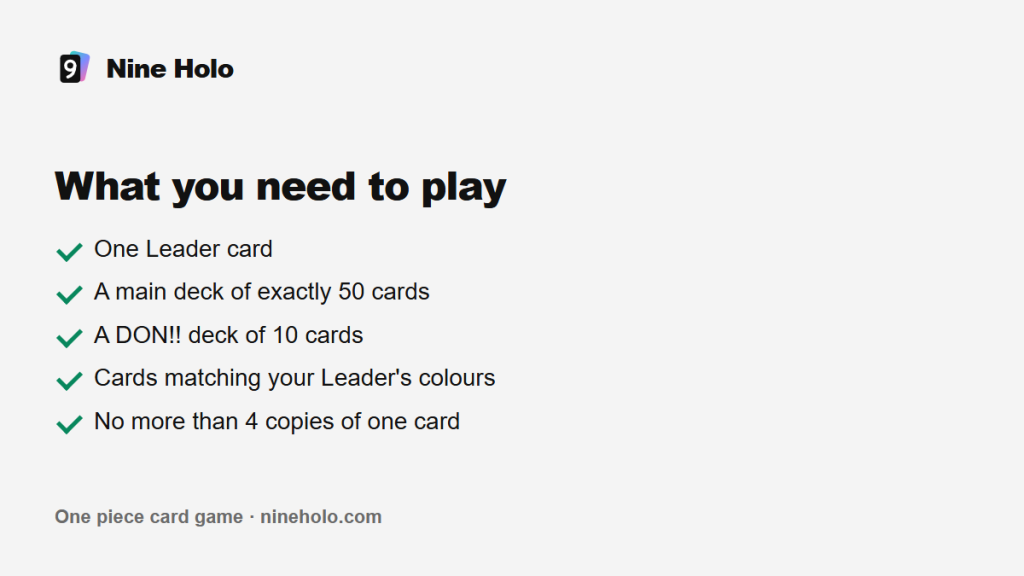
You do not need the full rulebook to understand the shape of a game in the One Piece Card Game. Each player brings three things: one Leader card, a main deck of exactly 50 cards, and a separate DON!! deck of 10 cards.
The Leader starts in play and is never shuffled into the deck. It has a Life value printed on it, usually four or five. At the start of the game each player sets aside that many cards from the top of their deck, face down, as Life cards. When your Leader takes damage, you take one of your Life cards into your hand. When you have no Life cards left and your Leader takes one more hit, you lose.
DON!! cards are the game’s resource. Each turn you add DON!! cards from your DON!! deck to your play area, and you spend them in two ways: to pay the cost of playing cards from your hand, and to attach to your Leader or Characters to boost their power for the turn. That choice, between playing more cards and making the ones you have stronger, is at the heart of the One Piece Card Game.
Attacks are straightforward. You rest one of your cards to attack the opposing Leader or a rested opposing Character, compare power, and the defender may use Blocker abilities or Counter values from cards in hand to stop it. Games are quick, and the Life system means the player who is behind keeps drawing extra cards, so comebacks are common.
3. The four card types
Every card in the One Piece Card Game is one of four types.
- Leader. The character your deck is built around. The Leader sets your Life total and decides which colours you may use. The Leader is not part of the 50-card deck.
- Character. Crew members, allies and enemies that you play to the field to attack and defend. Most of a deck is Characters.
- Event. One-off effects played from your hand, then put in the trash.
- Stage. Locations and ships that stay in play and give an ongoing benefit.
DON!! cards are a fifth kind of card, kept in their own deck. They have no cost and no colour, and special-art DON!! cards are collectable in their own right.
4. The six colours
Cards in the One Piece Card Game come in six colours, and each has its own style of play.
- Red is aggressive, boosting power and removing weaker Characters.
- Green controls the board by resting and re-readying cards.
- Blue returns cards to hand or deck and manipulates what you draw.
- Purple speeds up or reuses DON!! cards to play big cards early.
- Black reduces costs and removes Characters, often using the trash.
- Yellow works with Life cards and Trigger effects.
In the One Piece Card Game, your Leader’s colour decides which cards you can include. A single-colour Leader uses only that colour. Many Leaders have two colours, which opens up more combinations. You may include up to four copies of any card with the same card number.
5. Rarities in the One Piece Card Game
In the One Piece Card Game, rarity is printed as letters in the bottom corner of the card, next to the card number.
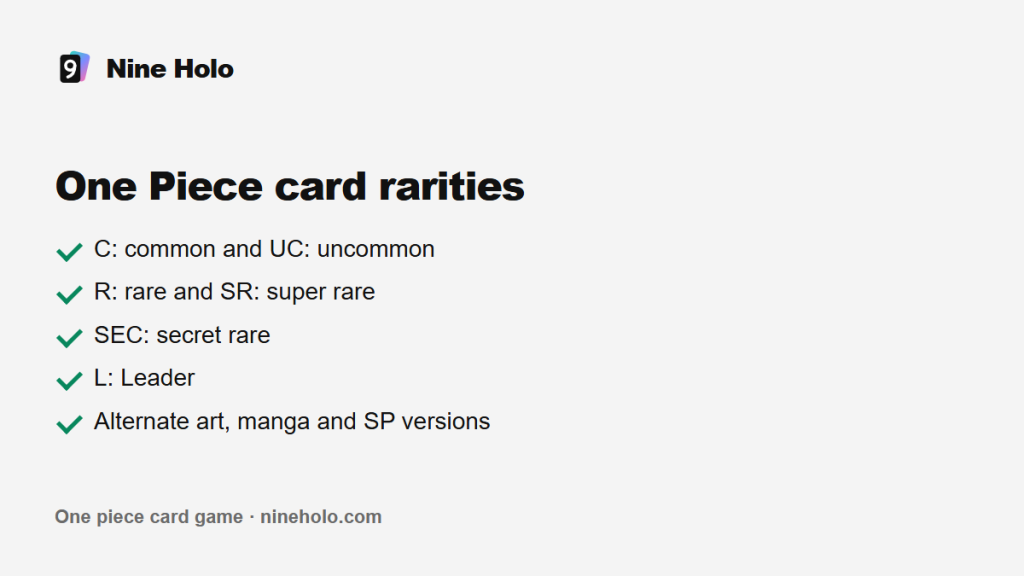
- C: common.
- UC: uncommon.
- R: rare.
- SR: super rare.
- SEC: secret rare, the highest regular rarity in a set.
- L: Leader.
- P: promotional cards given out at events, in products and through campaigns.
On top of these come the versions collectors chase. Most higher-rarity cards also exist as an alternate art, often called a parallel, with different, usually full-card artwork. Alternate art versions carry the same card number and work identically in the game, but they are much harder to pull.
Rarer still are the manga rares, alternate art cards with a background made of panels from the original manga. Typically there is only one or a very small number in a set, and they are among the most valuable cards in the One Piece Card Game. SP cards are special reprints of popular cards with new artwork, inserted at very low rates, and there are also Treasure Rare cards in some sets. For collectors, these alternate versions are the heart of the hobby.
6. How sets and codes are organised
Every product in the One Piece Card Game has a code, and learning to read the codes makes the catalogue much easier to follow.
- OP stands for a main booster set. OP-01 is Romance Dawn, the first set, and the number rises with each release.
- ST stands for a starter deck: a ready-to-play deck built around one Leader.
- EB stands for an extra booster, a smaller set released between main sets.
- PRB stands for a premium booster, a special set made up largely of reprints with new treatments.
Every card number in the One Piece Card Game repeats the code. A card numbered OP01-001 is card 001 from set OP-01. Because alternate art versions share the number of the regular card, the number alone does not tell you which version you have; the artwork does.
Some later English products combine two Japanese releases, which is why you will occasionally see a booster box with two codes on it. Check the product name and code together when comparing prices.
7. What the sealed products contain
The One Piece Card Game is sold in a small number of clear formats.
- Booster pack. A single pack of cards from one set. English main-set packs contain 12 cards.
- Booster box. A sealed display of booster packs, 24 in a standard English main-set box. This is how most collectors and players open a set. See our One Piece booster boxes.
- Case. A sealed carton of booster boxes as shipped by the distributor. The rarest cards are often quoted as appearing roughly once per case or less.
- Starter deck. A fixed 50-card deck with its Leader and DON!! cards, ready to play. See our One Piece decks.
- Double packs, gift collections and premium sets. Bundles that combine a few packs with promo cards or accessories.
Pull rates for the One Piece Card Game are not officially published and differ between sets, so treat any figures you read as estimates. As a general pattern, a booster box contains a set number of super rares, a secret rare in some boxes, and a small number of alternate art cards, while a manga rare is far rarer than one per box.
If you are new to sealed product in general, our guide to booster boxes and other sealed formats explains the thinking behind buying by the box.
8. English or Japanese cards?
The One Piece Card Game is printed in several languages, and for most buyers the choice is between English and Japanese. Both are genuine, official cards, but they are not interchangeable.
- Tournament play. Organised events are generally run by language region, so if you want to compete, buy the language used where you play.
- Release timing. Japanese sets are released first, with English sets following some months later.
- Price. The same card can sell for quite different prices in the two languages. Japanese sealed product is often cheaper per box, while certain English cards carry a premium, and the reverse can also be true.
- Box contents. Pack sizes and box configurations can differ between the Japanese and English versions of a set.
Listings should always state the language. If a price looks unusually low, check that you are comparing the same language before assuming it is a bargain. There is also an English version distributed in parts of Asia, which may be labelled as such.
What to buy first for the One Piece Card Game
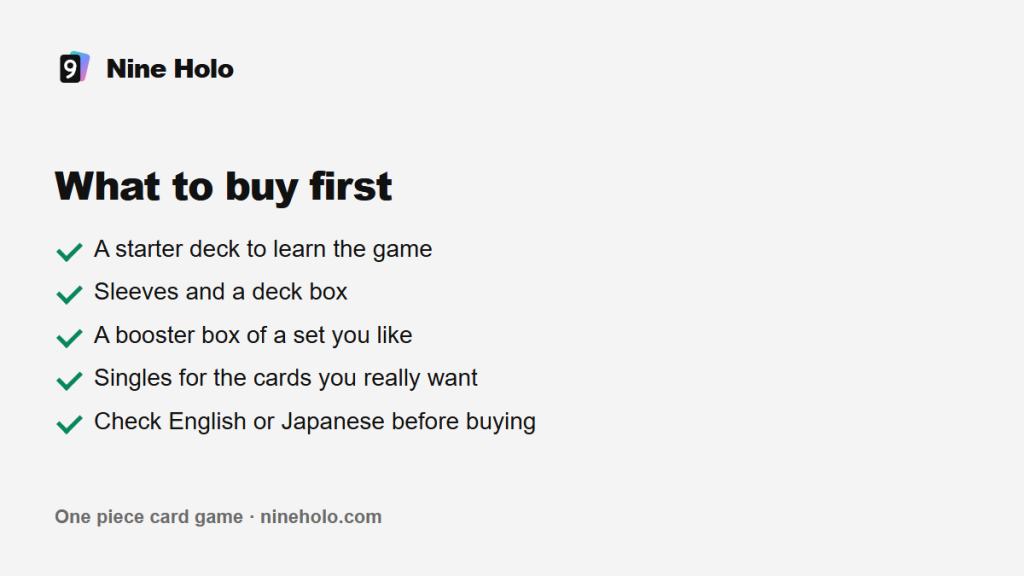
If you want to play the One Piece Card Game, start with a starter deck. It contains a Leader, a complete 50-card deck and the DON!! cards, and it is designed to work straight out of the box. Two different starter decks give two people everything they need for a first game. Add sleeves, because cards are shuffled constantly, and a deck box.
If you want to collect, choose one set whose characters or artwork you like, and decide between a booster box and single cards. A booster box gives you the fun of opening packs and a broad spread of the set. Single cards let you go straight to the versions you want, which is usually cheaper if you are after one particular alternate art.
Many people do both: a box or two of a favourite set, then singles and graded cards for the pieces that matter most. You can see everything in one place under One Piece in our shop.
Collecting and protecting One Piece cards
The cards that hold value in the One Piece Card Game are the alternate art cards, manga rares, SP cards, sought-after Leaders and scarce promos. Their value depends heavily on condition, and the dark borders on many cards show edge wear readily.
Sleeve any card above a rare as soon as it comes out of the pack, and put the best ones in a rigid holder. Our trading card storage guide covers sleeves, toploaders, binders and the conditions cards should be kept in. If you buy raw singles, the card condition guide explains what Near Mint and Lightly Played should mean.
The most valuable cards are often bought graded. A grading company such as PSA or Beckett authenticates the card, scores its condition and seals it in a protective case. Our explanation of the PSA grading scale shows what the numbers mean. As with any popular card game, counterfeits exist, so buy expensive cards from sellers who show the actual item.
Reading a One Piece card
Every card in the One Piece Card Game carries the same pieces of information, and knowing where they are makes the rules much easier to follow.
- Cost. The number in the top left corner of a Character, Event or Stage card. It is how many DON!! cards you must rest to play it.
- Power. The large number on Leaders and Characters, used when attacking and defending.
- Counter. A value printed on the side of many Character cards. You can discard the card from your hand during the opponent’s attack to add that amount to your defender’s power.
- Attribute. A symbol such as Slash, Strike, Ranged, Special or Wisdom, which some effects refer to.
- Type. The crews and groups the card belongs to, such as Straw Hat Crew. Many effects work only with a particular type.
- Effect text. What the card does, with keywords in bold. Common keywords include Rush, which lets a Character attack on the turn it is played, Blocker, which lets it take an attack aimed elsewhere, and Trigger, an effect that can be used when the card is taken from Life.
- Card number and rarity. In the bottom corner, as described above.
Once you can read those, you can pick up any card in the One Piece Card Game and understand what it does.
How to learn and where to play
The quickest way to learn the One Piece Card Game is to play a few games with starter decks, with the rule sheet beside you. The official website has a tutorial and the full rules, and there is an official teaching app that walks through a game step by step.
When you are ready for more, many local game shops run regular events, from relaxed casual nights to store tournaments that award promotional cards. These events are where many of the promo cards collectors want come from. Larger regional and national events sit above them, with their own prize cards.
You do not have to compete to enjoy the One Piece Card Game. Plenty of people only collect, and plenty play only at the kitchen table. But even one evening at a local event is a good way to see how decks are built and which cards people value.
Common beginner mistakes in the One Piece Card Game
- Mixing up languages. Always check whether a product is English or Japanese before comparing prices.
- Confusing regular and alternate art. They share a card number. Look at the artwork and the listing title.
- Chasing one card by opening boxes. The rarest cards appear very seldom. Buy the single.
- Building a deck with the wrong colours. Every card must match a colour of your Leader.
- Playing valuable cards unsleeved. Shuffling wears edges quickly.
- Buying every release. Sets arrive frequently. Pick the ones you care about.
Frequently asked questions
Is the One Piece Card Game hard to learn?
No. The basic turn is simple, and a starter deck with the printed rules is enough to play a first game in a few minutes. Depth comes from deck building and from deciding how to spend DON!! cards.
Do I need to know the story?
No. The One Piece Card Game plays perfectly well without it, though knowing the characters adds to the enjoyment.
How many cards are in a deck?
One Leader, exactly 50 cards in the main deck and 10 DON!! cards, with no more than four copies of any card number.
What is a manga rare?
An extremely scarce alternate art card with a background of panels from the manga. They are among the most valuable cards in each set that has one.
How many packs are in a booster box?
A standard English main-set booster box contains 24 packs of 12 cards. Japanese boxes and special sets can differ, so check the product description.
The short version
The One Piece Card Game is a two-player game built around a Leader, a 50-card deck and 10 DON!! cards. Cards come in four types and six colours, with rarities from common to secret rare and a layer of alternate art, manga rare and SP versions above them. Sets are coded OP for main boosters, ST for starter decks and EB for extra boosters. Start with a starter deck if you want to play, or a booster box and a few singles if you want to collect, and always check the language before you buy.