
Sports Card Terms: 45 Essential Words Every Smart Collector Needs
Sports card terms can make a simple hobby sound like a foreign language. A listing might read “2023 Prizm Silver RC PSA 10, low pop”, and to a newcomer almost none of that means anything. Yet every one of those sports card terms has a plain meaning, and once you know a few dozen of them you can read any listing, follow any box break and understand what you are being offered.
This glossary explains 45 essential sports card terms in everyday English. They are grouped by topic rather than alphabetically, so that related ideas sit together: the types of cards, numbering and scarcity, autographs and memorabilia, boxes and packs, grading, and the words used when buying and selling. The same vocabulary is used across basketball, football, baseball, soccer, hockey and most other sports.
You do not need to learn all of these sports card terms at once. Read the first two sections, and come back to the rest as the words turn up.
In this guide
Why sports card terms matter
Sports card terms are shorthand for value. The difference between a base card and a numbered parallel of the same player, or between a sticker autograph and an on-card autograph, can be a large difference in price, and it is all communicated in a few abbreviated words in a title. Buyers who do not know the sports card terms either overpay or miss good cards.
Knowing the sports card terms also protects you. Descriptions are sometimes written to sound more impressive than the card deserves. Knowing exactly what “refractor”, “short print” or “rookie” should mean lets you check a claim against the card in the photograph.
Sports card terms for types of cards
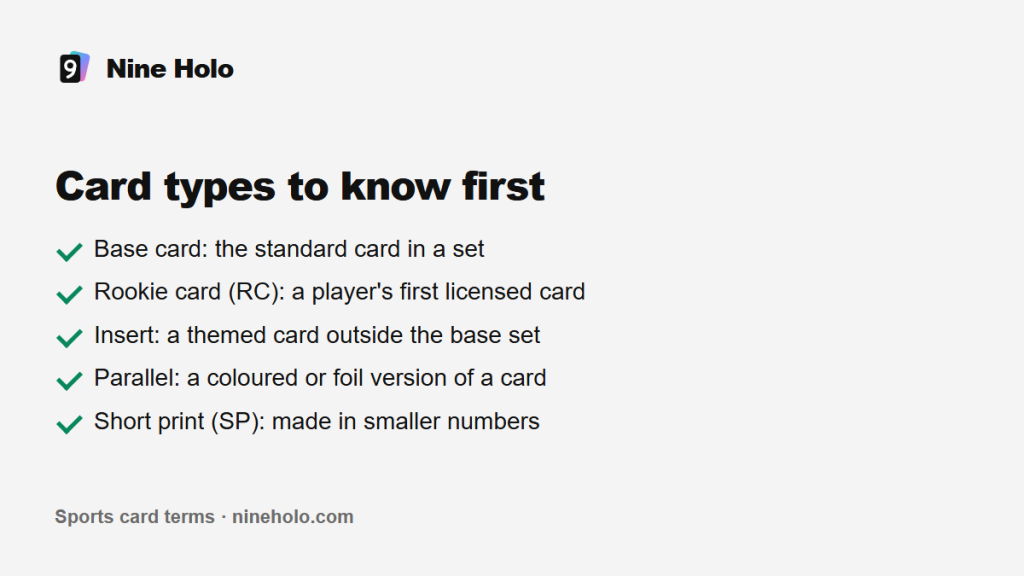
1. Base card
The standard card in a set, with the regular design and no special finish. Base cards make up most of every pack and are usually the least valuable version of a player’s card in that set.
2. Base set
The complete run of base cards in a product, numbered in sequence. Collectors who “build the set” are collecting every base card.
3. Rookie card (RC)
A player’s first officially licensed card in a major set, normally from their first professional season. Modern rookie cards carry an RC logo. Rookie cards are the most collected cards of any player and usually the most valuable.
4. Insert
A card from a themed subset that is separate from the base set, with its own name and design. Inserts appear less often than base cards, and some are extremely scarce.
5. Parallel
A version of a base or insert card with a different colour, pattern or finish. A product may have many parallels of the same card, each rarer than the last. Parallels are central to modern collecting.
6. Refractor
A parallel with a reflective coating that shows a rainbow sheen when tilted. The word originated with Topps Chrome products and is used loosely for similar shiny parallels.
7. Prizm
Both a Panini brand and the name of its refractor-style parallels. A “Silver Prizm” is the classic shiny parallel of that brand.
8. Chrome
Cards printed on a metallic, glossy chromium stock rather than plain paper. Chrome versions of a set are generally more sought after than the paper versions.
9. Variation
A card that shares a number with a base card but differs in some way, such as a different photograph. Variations can be hard to spot and are often short printed.
10. Error card
A card released with a mistake, such as a wrong name, statistic or photograph. If the error was corrected during the print run, both versions exist, and one may be much scarcer than the other.
Sports card terms for scarcity and numbering
11. Serial numbered
A card stamped with its own number out of a fixed print run, written like 25/99. The second number is how many exist. Lower print runs generally mean higher value.
12. One of one (1/1)
A card of which only a single copy was made. The rarest kind of card in any product.
13. Short print (SP)
A card produced in smaller quantities than the rest of the set, without necessarily being serial numbered.
14. Super short print (SSP)
A card that is rarer still than a short print. Many of the most desirable modern inserts are super short prints.
15. Print run
The total number of copies made of a card. For numbered cards it is printed on the card; for others it is often unknown and has to be estimated.
16. Case hit
A card so scarce that, on average, only one appears in a whole sealed case of boxes. Case hits are among the most chased cards in modern products.
17. Jersey number match
A serial-numbered card whose number matches the player’s jersey number, for example 23/99 for a player who wears 23. Some collectors pay a premium for these.
18. Printing plate
One of the metal plates used to print a card, inserted into packs as a one-of-one. There are normally four per card, one for each ink colour.
Sports card terms for autographs and memorabilia
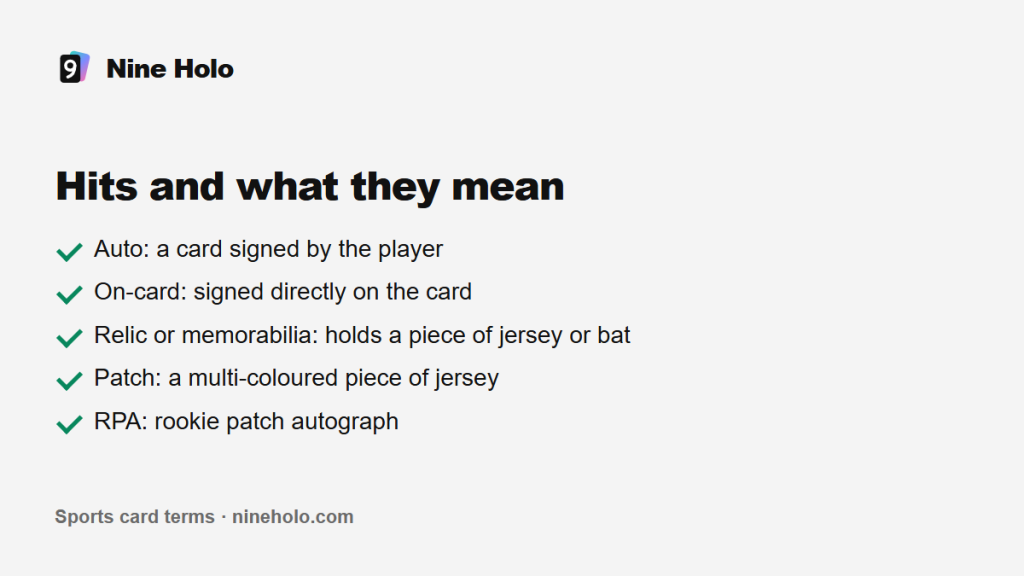
19. Autograph (auto)
A card signed by the player and certified by the manufacturer. Autographs are the main reason people buy hobby boxes.
20. On-card autograph
An autograph signed directly on the surface of the card. Collectors generally prefer these.
21. Sticker autograph
An autograph signed on a clear sticker that the manufacturer then applies to the card. It is genuine, but usually valued a little below an on-card signature.
22. Relic or memorabilia card
A card containing a piece of an item such as a jersey, bat, ball or glove. Read the back of the card carefully, because the wording states whether the item was used in a game, worn by the player, or simply associated with them.
23. Patch
A memorabilia card with a multi-coloured piece of jersey, usually from a logo, number or nameplate. Patches are valued more highly than plain single-colour swatches.
24. Game-used and player-worn
“Game-used” means the item was used in an official game. “Player-worn” means the player wore it, possibly only at a photo shoot. The first is more desirable.
25. RPA
Rookie patch autograph: a rookie card that carries both a jersey patch and an autograph. In premium products, RPAs are the cards everyone is hoping for.
26. Redemption
A card inserted in place of an autograph that was not ready when the product was packed. The owner enters a code with the manufacturer and receives the real card later. Redemptions expire, so check the date.
27. Hit
A general word for any valuable pull: an autograph, a memorabilia card, a low-numbered parallel or a rare insert.
Sports card terms for boxes and packs
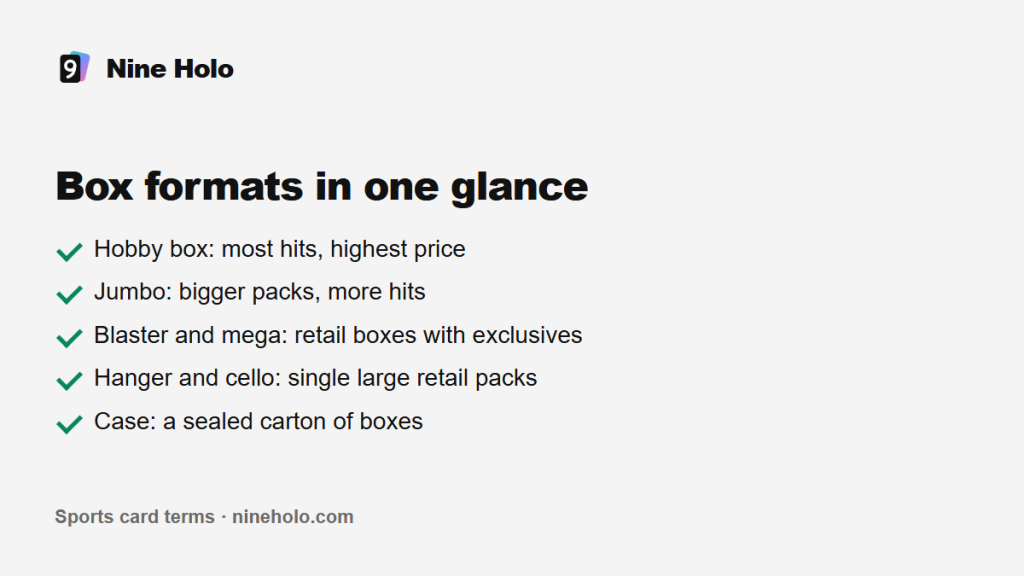
28. Hobby box
A box made for card shops and online dealers. Hobby boxes cost more and, in many products, state on the box how many autographs or memorabilia cards to expect. See our sports card hobby boxes.
29. Jumbo box
A larger hobby format with more cards per pack and often more hits per box.
30. Retail
Products made for general stores rather than card shops. Retail costs less and usually offers fewer autographs, but it has its own exclusive parallels.
31. Blaster box
A small retail box containing a handful of packs. A popular, affordable way to open a product.
32. Mega box
A larger retail box, frequently with parallels that appear only in mega boxes.
33. Hanger box and cello pack
Single large retail packs sold on a peg. They are inexpensive and sometimes carry their own exclusive parallels. You can browse these formats under blaster, mega and retail boxes.
34. FOTL
First Off The Line: an early-release hobby box, sold in limited quantities, with parallels found nowhere else.
35. Case
The sealed carton in which boxes are shipped from the manufacturer. A case holds a set number of boxes, which differs by product.
36. Box break
An event, usually streamed online, where one or more boxes are opened and the cards are divided among people who bought a share, often by team. Our guide to hobby boxes compared with blaster boxes explains what each format offers before you buy in.
37. Wax
Slang for sealed, unopened boxes and packs. The word comes from the wax paper wrappers used on vintage packs.
Sports card terms for grading and condition
38. Raw
A card that has not been professionally graded.
39. Graded and slab
A graded card has been authenticated and scored for condition by a grading company, then sealed in a hard plastic case called a slab. The best-known companies are PSA, Beckett (BGS) and SGC.
40. Gem Mint
The top condition tier: a PSA 10 or a BGS 9.5. Our guide to the PSA grading scale explains every grade beneath it.
41. Centering
How evenly the image is positioned within the card’s borders. Centering is fixed at the factory and is one of the four things graders assess.
42. Pop report
The population report: a public count kept by each grading company of how many copies of a card have received each grade. “Low pop” means few copies exist at that grade.
43. Crossover
Sending a card graded by one company to another company to be graded again, in the hope of an equal or better result in a more desirable slab.
Sports card terms for buying and selling
44. Comps
Comparable sales: recent sold prices for the same card in the same condition. Comps are how collectors work out what a card is actually worth, as opposed to what someone is asking.
45. PC
Personal collection: the cards a collector keeps because they like them, not to sell. “PC player” means the player someone collects.
How to read a listing using these sports card terms
Put the sports card terms together and a listing becomes easy to decode. Take the example from the start of this guide: “2023 Prizm Silver RC PSA 10, low pop”.
- 2023 Prizm is the year and the product.
- Silver tells you it is the shiny Silver Prizm parallel, not the base card.
- RC tells you it is the player’s rookie card.
- PSA 10 tells you it has been graded Gem Mint by PSA.
- Low pop claims that few copies exist at that grade, which you can confirm in the population report.
Listings built from these sports card terms generally follow the same order: year, brand and product, player, card type or parallel, serial number if any, and the grade. Once you are used to it, you can judge a card in a few seconds, then check the photographs to confirm that the card matches the words.
Which sports card terms affect price the most
Not all sports card terms carry the same weight. If you are trying to work out why two cards of the same player differ so much in price, look for these first.
- Rookie. A player’s rookie cards are almost always worth more than cards from later years.
- Serial number. The lower the print run, the higher the price, with one-of-ones at the top.
- Autograph. A certified signature adds value, and on-card signatures add more.
- Grade. The step from one grade to the next can outweigh everything else, especially at the top.
- Brand. Each sport has flagship products whose cards are the market standard, and the same player’s card in a lesser product sells for less.
A card that combines several of these sports card terms, such as a low-numbered rookie patch autograph in a high grade, sits at the top of the market. A base card of a veteran sits at the bottom. Most cards fall somewhere between.
Common mistakes with sports card terms
- Treating every shiny card as a refractor. Many base cards are glossy. A true refractor or Prizm parallel is normally labelled on the back of the card.
- Calling any first-year card a rookie card. Inserts and pre-professional cards from the same year are not the official rookie card. Look for the RC logo.
- Assuming “numbered” means valuable. A card numbered to several thousand is not scarce. The size of the print run matters.
- Reading “memorabilia” as “game-used”. Check the wording on the back.
- Using asking prices as comps. Only completed sales show what a card is worth.
Brand names that work like sports card terms
Some product names are used so often that they behave like sports card terms in their own right. You will see them in almost every listing, so it helps to know roughly what they refer to.
- Topps is one of the oldest names in the hobby, long associated with baseball. Its flagship set and its Chrome products are reference points for collectors.
- Bowman is a Topps brand focused on prospects, players who have not yet reached the top level. A player’s first Bowman card is closely followed.
- Panini has produced many of the best-known basketball and football products, including Prizm, Select, Mosaic, Donruss and Optic, and the premium National Treasures line.
- Upper Deck is the leading name in hockey cards, and its Young Guns rookie cards are a hockey standard.
Which company holds the licence for a league changes over time, so the brand on a player’s rookie card depends on the year. When a listing names a product, that name is telling you which design, which parallels and which place in the market the card belongs to.
Slang you will hear at shows and in breaks
Beyond the formal sports card terms, the hobby has a layer of slang. None of it is essential, but it helps to recognise it.
- Rip. To open packs or boxes.
- Pull. A card you got from a pack, especially a good one.
- Chase card. The card everyone is hoping for in a product.
- Flip. To buy a card and resell it quickly.
- Hold. To keep a card in the expectation that its value will rise.
- Prospecting. Buying cards of young players before they are established.
- Junk wax. Cards from the late 1980s and early 1990s, when products were printed in enormous quantities and most remain inexpensive.
- Mojo. A general word for a great pull.
Slang changes quickly and differs between communities. If someone uses a word you do not know, ask. Collectors are usually happy to explain, and asking is how most people learned these sports card terms in the first place.
Frequently asked questions
What are the most important sports card terms for a beginner?
Base, rookie card, parallel, numbered, autograph, hobby box, raw and graded. With those eight sports card terms you can understand most listings.
What does RC mean on a card?
It marks the card as an official rookie card, the player’s first licensed card in a major set.
Is a parallel the same as an insert?
No. A parallel is a different-looking version of an existing card. An insert is a separate card from its own themed subset. Inserts can have parallels too.
What does /99 mean?
That only 99 copies of that card were made, each stamped with its own number.
Are retail boxes worth buying?
Yes, if you want an affordable way to open packs or you are chasing retail-only parallels. For autographs, hobby boxes offer better odds.
The short version
Sports card terms describe four things: what kind of card it is, how scarce it is, whether it carries an autograph or memorabilia, and what condition it is in. Learn rookie, parallel, numbered, auto, hobby, raw and graded first, and the rest of the sports card terms will fall into place as you see them used.
To see the vocabulary in action, browse our sports cards, including graded singles. And once cards arrive, our trading card storage guide explains how to keep them in the condition you bought them in.