Trading Card Storage: 9 Proven Ways to Protect Your Collection
Trading card storage is the least exciting part of collecting and the part that decides what your cards are worth in ten years. A card that leaves the pack in perfect condition can lose most of its value to a bent corner, a faded surface or a warped edge, and almost all of that damage happens quietly, in a drawer or a shoebox, long after the card was pulled.
This guide walks through trading card storage from the single sleeve up to the room the collection lives in. It covers raw cards, graded slabs and sealed product, and it applies equally to Pokémon, sports cards, One Piece and every other game. None of it is expensive. Most good trading card storage costs a few cents per card, and the mistakes it prevents cost far more.
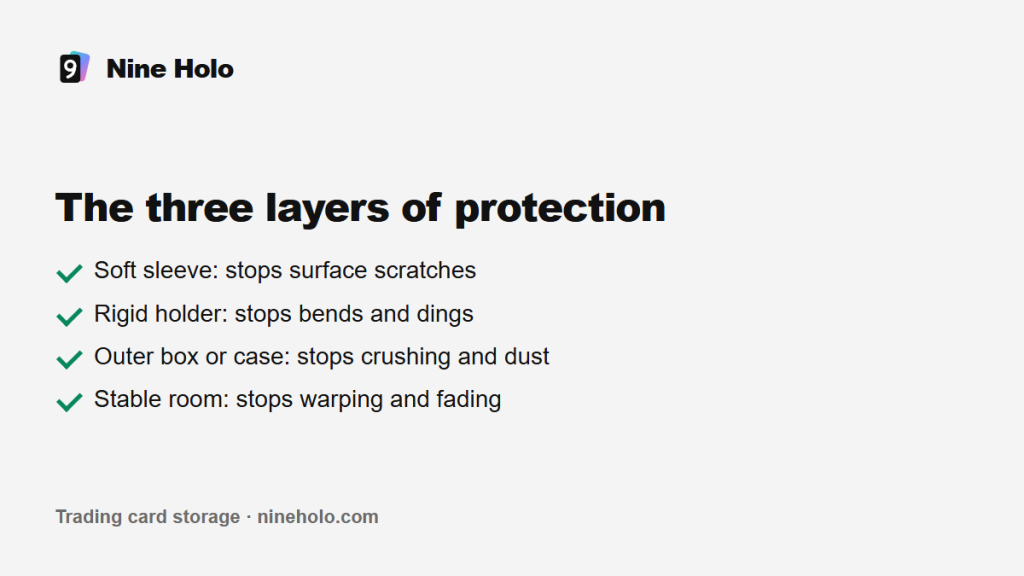
If you only remember one idea, make it this: good trading card storage comes in layers. A soft layer guards the surface, a rigid layer guards the shape, an outer container guards against crushing and dust, and a stable room guards against the slow damage of moisture, heat and light.
In this guide
Why trading card storage matters more than most collectors think
Card condition is graded on four things: centering, corners, edges and surface. You cannot change centering after a card is printed, but the other three are decided almost entirely by how the card is handled and stored. A light scratch across a holographic surface, a corner that has gone soft, or whitening along an edge can each drop a card by one or more grades.
On a valuable card, one grade is not a small difference. The gap between a top grade and the grade below it is often a large multiple of the price, because top-condition copies are scarce. That scarcity exists precisely because most cards were stored badly. Good trading card storage is, in a real sense, how the scarce copies are made.
Trading card storage also matters for cards you never plan to sell. Cards warp, fade and stick together when they are neglected, and a collection that has been cared for is simply nicer to own, look through and pass on.
1. Sleeve every card you want to keep
The soft sleeve, often called a penny sleeve, is the foundation of trading card storage. It is a thin, clear pocket that stops the card surface from rubbing against anything else. Surface scratches come from cards sliding against each other, against a table or against the inside of a hard holder, and a sleeve prevents all three.
Choose sleeves that are labelled acid-free and free of PVC. Polypropylene is the standard safe material. Slide the card in gently from the top, holding it by the edges, and never force a card into a sleeve that feels tight. For cards in thicker stock, such as memorabilia or patch cards, buy sleeves sized for thick cards so that the corners are not squeezed.
It is the cheapest step in trading card storage. Sleeving takes seconds and costs almost nothing, which is why experienced collectors sleeve cards straight out of the pack, before the cards touch any other surface.
2. Add a rigid holder for anything valuable
A sleeve protects the surface but does nothing to stop a card from bending. For that you need a rigid layer, the second layer of trading card storage. There are three common choices, and each has a job.
- Toploaders are hard plastic holders open at the top. They are the everyday choice for valuable raw cards. Always sleeve the card first, because a bare card can scratch as it slides against hard plastic.
- Semi-rigid holders are thinner and slightly flexible. Grading companies generally prefer cards to be submitted in these, because the card is easy to remove without touching the edges.
- One-touch magnetic cases are thick two-piece holders that close with a magnet. They display beautifully and many include UV protection. Buy the size that matches the thickness of the card, measured in points, so the card neither rattles nor gets pinched.
Whichever holder you use, match the size to the card. A holder that is too large lets the card slide around and wear its corners. A holder that is too small presses on the edges. To stop dust entering a toploader, slip the loaded toploader into a resealable team bag rather than taping the top shut, since tape leaves residue and can touch the card.
3. Use binders the right way
Binders are the most enjoyable form of trading card storage, because they let you actually look at a set. They are also where a lot of damage happens, so the details matter.
Use pages made from polypropylene, not PVC. Older vinyl pages contain plasticisers that can cloud, become sticky and transfer to the card over the years. Side-loading pages hold cards more securely than top-loading pages and keep dust out, and they make it harder for a card to slide out when the binder is turned over.
The binder itself matters too. Classic round-ring binders can press the rings into the cards nearest the spine and leave a dent. D-ring binders hold pages flat and are much safer, and ringless binders with pages stitched into the cover remove the risk completely. Do not overfill a binder. When the pages start to bulge, the pressure lands on the cards, so start a second binder instead.
Sleeve cards before they go into binder pages. It keeps the surface clean when you slide a card in and out, and it means the card never touches the page directly. Store binders upright on a shelf, like books, or flat with nothing stacked on top.
4. Choose the right box for bulk
Most collections are mainly bulk: commons, base cards and duplicates. Sleeving thousands of cards is not realistic, and it is not necessary. For bulk, the right trading card storage is a purpose-made cardboard storage box, sold in sizes named by how many cards they hold.
These boxes are cut to card dimensions, so the cards stand in rows and cannot slide around. Fill each row so that the cards stand upright without leaning, and use a spacer or a block of foam if a row is only partly full. Leaning cards slowly take on a curve. Do not pack rows so tightly that you have to force cards in or out, because that is how edges get chipped.
Avoid shoeboxes, rubber bands and loose stacks. Rubber bands dent the edges of the outer cards and eventually decay and stick to them. Loose stacks let cards rub against each other every time the stack moves. If you want something sturdier than cardboard, plastic card cases with latching lids work well, as long as the cards inside are still kept in snug rows. Either way, bulk trading card storage should keep cards upright and still.
5. Control humidity and temperature
Cards are layers of paper and coating, and paper reacts to moisture. In damp air a card absorbs water and swells; in dry air it gives the water back. Because the front and back of a card are finished differently, the two sides move at different rates, and the card curls. Foil and holographic cards are the most sensitive, which is why foils so often arrive from the pack with a slight curve.
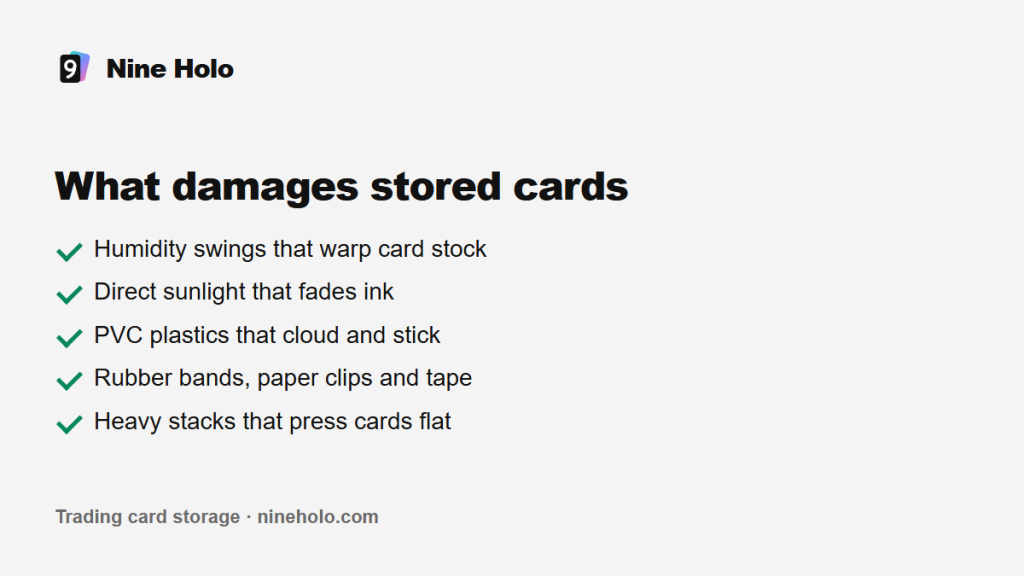
The goal of trading card storage is stability rather than a perfect number. A room that people are comfortable living in, with moderate humidity and a steady temperature, suits cards well. What harms them is swinging between extremes, so the worst places in most homes are the attic, the garage, the basement and anywhere next to a radiator, a vent or an outside wall that gets damp.
Simple steps go a long way. Keep boxes off the floor, where damp and spills reach first. Add silica gel packets to closed boxes and replace them from time to time, since they stop absorbing once they are saturated. In a humid climate, a small dehumidifier in the room does more than any amount of packaging. An inexpensive humidity gauge takes the guesswork out of it.
6. Keep cards out of the light
Light is the part of trading card storage that people forget. Sunlight fades ink. It happens slowly enough that you will not notice from one month to the next, and by the time you do, the damage is permanent. Reds and yellows tend to fade first, and autographs, especially those signed in ordinary ink, are even more vulnerable than the printing.
For stored cards the answer is simple: keep them in closed boxes or binders, away from windows. Displayed cards need more thought. Choose a wall that never receives direct sun, use holders or frames with UV protection, and consider rotating which cards are on display so that no single card sits in the light for years. UV-protective cases reduce the damage but do not remove it, so placement still matters.
7. Store graded slabs upright and padded
A graded card is sealed in a hard plastic slab by a grading company such as PSA or Beckett. The slab does most of the protective work, so trading card storage for slabs is mostly about protecting the case, which is not indestructible. Slabs scratch easily, and a scratched case makes the card harder to see and less attractive to a buyer even though the card inside is untouched.
Put each slab in a fitted slab sleeve to keep the case clear. Store slabs upright in a box made for them, in rows, with a little padding so they cannot knock together. Do not stack slabs in tall piles, and do not leave them loose in a drawer. Cases can crack if they are dropped or squeezed, and a cracked case usually means sending the card back to be reholdered.
Slabs are not sealed against the environment either. Everything said above about humidity, temperature and light applies to graded cards exactly as it does to raw ones. If you are deciding whether a card is worth grading at all, our guide to how PSA and BGS grading works explains what the graders look at.
8. Protect sealed boxes too
Sealed product needs trading card storage of its own. The value of a sealed booster box, Elite Trainer Box or hobby box depends on the condition of the packaging and, above all, on the factory shrink wrap. A torn wrap, a crushed corner or a dented lid lowers the price even when every pack inside is perfect.
Store sealed boxes flat or upright on a shelf, never under heavy stacks. Clear acrylic cases made to fit common box sizes protect corners and wrap and make the boxes easy to display. If you keep boxes in the shipping carton they arrived in, do not stack cartons more than a few high, and keep the carton off the floor.
Shrink wrap becomes brittle with heat and age, so the same rules about temperature and sunlight apply. Handle sealed boxes by the body rather than by the wrap, and resist the urge to press on the plastic to see what is underneath. If you are still choosing what to put away, you can browse sealed booster boxes and Elite Trainer Boxes in our shop.
9. Organise, label and check your collection
Good trading card storage is also about being able to find things. Every time you dig through a box hunting for one card, you handle dozens of others. An organised collection is handled less, and cards that are handled less stay in better condition.
Pick a trading card storage system and keep to it. Sorting by game, then set, then card number works for most collectors. Sports collectors often sort by sport, year and brand instead. Label the outside of every box with what is inside, and use dividers within boxes so that you can go straight to the right section.
Keep a simple inventory of the cards that matter: what the card is, its condition, what you paid and where it is stored. A spreadsheet is enough. For valuable collections, take photographs and find out whether your home insurance covers collectibles, because many policies limit or exclude them unless they are listed separately.
Finally, look at the collection at least twice a year. Open the boxes, check for any smell of damp, look at a few cards from each row for curling, and replace silica gel packets. Problems caught early are usually easy to fix; problems found after five years usually are not.
Common trading card storage mistakes
Most trading card storage damage comes from a short list of habits. If you avoid these, you are already ahead of most collectors.
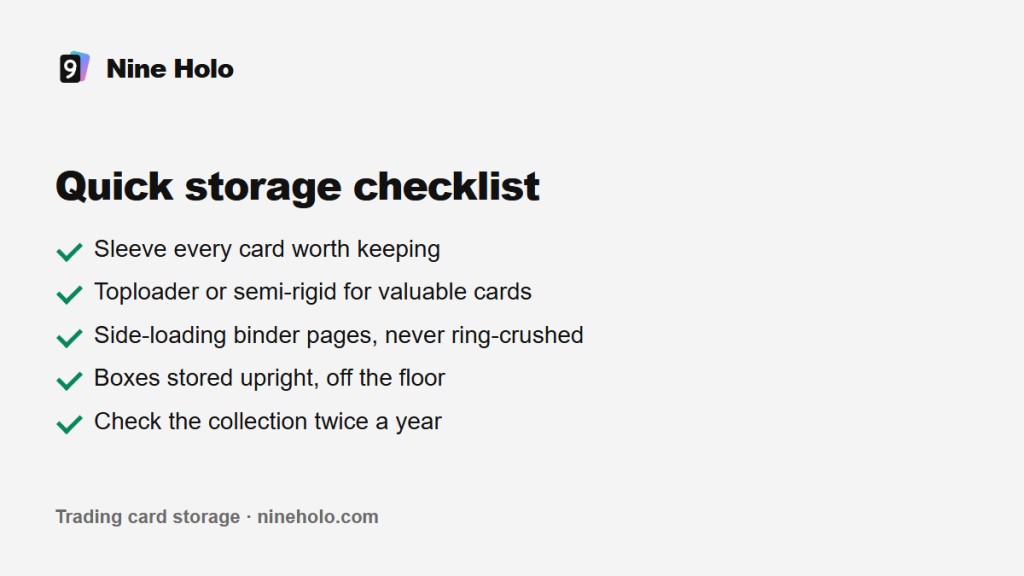
- Using rubber bands or paper clips. Both dent cards, and rubber decays and sticks.
- Putting bare cards into toploaders. Hard plastic can scratch an unsleeved surface.
- Keeping cards in PVC pages. Old vinyl pages cloud and can bond to the card.
- Storing in the attic, garage or basement. These rooms have the widest swings in heat and damp.
- Stacking heavy things on cards or sealed boxes. Weight crushes corners and flattens wrap.
- Screw-down holders tightened hard. Old-style screw cases can press a card flat and damage the surface; if you use them, choose recessed versions and never overtighten.
- Displaying favourite cards in a sunny room. Fading is slow and permanent.
- Handling cards with unwashed hands. Oils and moisture from skin mark glossy surfaces. Hold cards by the edges.
How much does good trading card storage cost?
Very little, compared with the cards it protects. Soft sleeves are sold in packs of a hundred for about the price of a single booster pack. Toploaders cost a little more per card and are bought in packs of twenty-five. A cardboard storage box that holds several hundred cards costs a few dollars. Magnetic cases, slab boxes and acrylic cases for sealed product cost more, but you only need them for the small part of a collection that justifies it.
A sensible approach to trading card storage is to match the spending to the card. Bulk goes into storage boxes with no sleeves. Cards you like, and anything holographic, get a sleeve. Cards with real value get a sleeve and a rigid holder. The few best cards get a magnetic case or go to a grading company. Sealed boxes you intend to hold get an acrylic case.
Trading card storage for travel and shows
Trading card storage at home is the easy part. Cards are at most risk when they move. If you are taking cards to a show, a shop or a friend’s house, use a hard-sided case with foam or snug rows, so that nothing can slide when the case is tipped. Carry valuable cards in toploaders or slabs inside the case, and keep the case with you rather than in a hot car, where temperatures climb quickly and shrink wrap and cards both suffer.
When you post cards, the same layered thinking applies: sleeve, rigid holder, team bag, padding and a mailer or box that cannot be bent. Postal services such as USPS publish their own packaging advice, and insurance is worth adding for anything you could not comfortably replace.
Frequently asked questions
Should I sleeve every card?
No. Sleeve the cards you care about and every holographic or valuable card. Bulk commons are fine standing in rows in a proper storage box.
Is it safe to keep cards in a binder long term?
Yes. A binder is safe trading card storage if the pages are PVC-free, the cards are sleeved, the binder has D-rings or no rings, and it is not overfilled. Store it upright in a room with steady conditions.
Can a curled card be flattened?
A slight curve caused by humidity often relaxes when the card rests in a sleeve and toploader in a stable room. Do not press cards under heavy weights or use heat, because both can cause damage that is worse than the curve.
Do graded cards still need care?
Yes. The usual trading card storage rules still apply: the slab protects against handling, but not against heat, damp, sunlight or drops. Use slab sleeves and store slabs upright in a padded box.
What is the best trading card storage for a beginner?
A pack of soft sleeves, a pack of toploaders, one cardboard storage box and a side-loading binder cover almost everything a new collector needs. Add specialised cases only when you own cards that justify them.
The short version
Good trading card storage comes down to four habits. Put a soft sleeve on anything you want to keep. Add a rigid holder to anything valuable. Keep everything in fitted boxes or safe binders, upright and off the floor. And choose a room with steady temperature and humidity, away from direct light. Do those four things and your cards will look the same in ten years as they do today.
When you are ready to add to the collection, you can browse every listing in our shop, or start with graded cards that already arrive in a protective slab.